GoodHolidayStore planning guide
One Christmas game, several ways to join in
Your youngest guest wants to run laps, your uncle wants a proper competition, and Grandma can't read the tiny print across the table. Start with one game everybody can see and follow, then give people different ways to join in. Picture bingo is the safest shared start. Family prompts reward people who know the family, and charades needs a few brave actors and plenty of guessers.
Look at the seating before you look at the ages
“Mixed age” doesn't tell you who can read a prompt, hear a caller or comfortably stand in front of everyone. Walk around the place where you'll play. Can the person in the corner see the calling picture? Is there enough light to write? Will someone need to move a dinner plate to hold a sheet?
Print one sample at the size you intend to use. Look at it from a normal seated distance. Full-page boards may be the better choice even when two-per-page printing saves paper. If someone needs help, ask quietly what would be useful rather than announcing it to the room.
Give people a way to join without doing every job. A younger guest can place markers beside an older reader. A grandparent can guess charades while someone else acts. Someone who's only just met the extended family can listen to a story instead of being expected to know everyone's childhood habits.
Start with picture bingo: everyone can see it
Christmas Bingo includes 50 player boards with center FREE spaces, 36 calling cards, a checklist, tokens and a host guide. The four non-editable PDFs cover A4 and US Letter, with full-page and two-per-page layouts. Each format contains the same 50 boards, so printing several formats doesn't create extra different boards.
Print a player board for each person who will play individually. Cut the complete calling set and enough tokens before the gathering. The full-page edition has a sheet of 25 markers and the two-per-page edition has 50; plan enough marker sheets for your group rather than assuming one sheet covers the room.
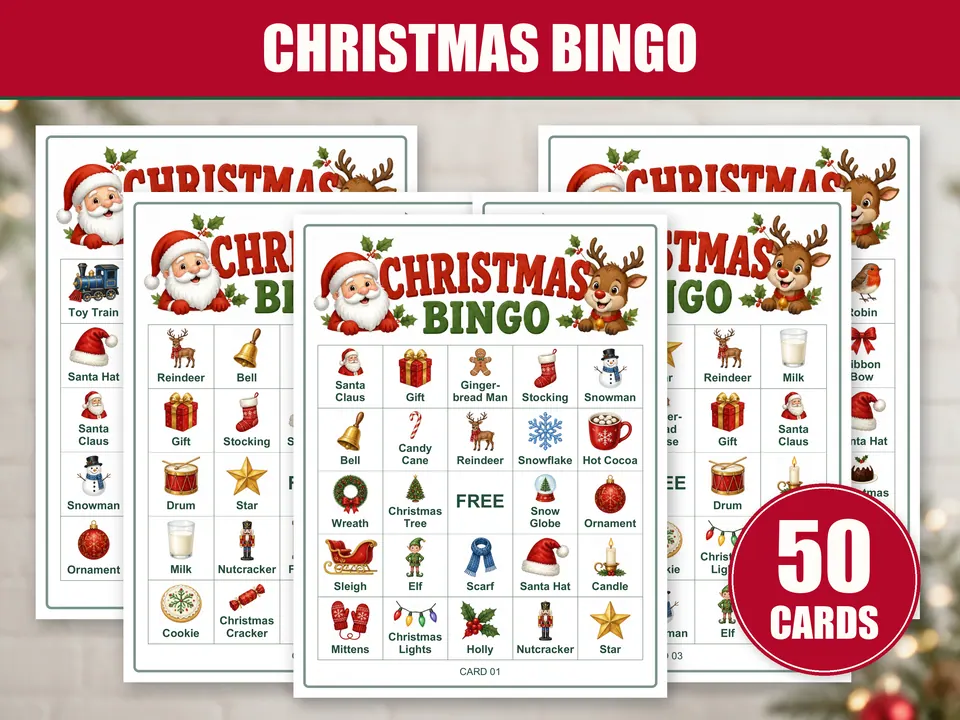
Read the host guide and agree on the winning pattern before drawing. Players mark FREE first. Shuffle all 36 calling cards, then draw one at a time, reading its label and showing its picture. Keep drawn calls and tick the checklist so you can check a claimed win against what was actually called.
The first good moment is often very small: someone spots the picture and points it out to their partner. Give that moment room. Don't call the next item while half the table is still finding the last one. A seated game can be lively without becoming a race to keep up with the caller.
Family quiz: great for insiders, tricky for newcomers
The Christmas Family Game asks players to match a family member to 15 festive descriptions. It comes as a one-page activity in A4 and US Letter, with name and score fields. Guests write a name for each prompt, reveal answers together and gain a point when the group agrees.
There's no fixed answer key because your family supplies the answers. That's the appeal when people know each other well: a name can lead to a funny memory. It can also leave a new partner or visiting friend staring at a page of questions they have no way to answer.
Invite mixed pairs to discuss answers together, or set aside scoring and share only a few responses. Explain that change at the start. A newcomer can ask “What's the story behind that?” without being the person who loses every point for not having attended Christmas ten years ago.
Read the prompts privately first. If your family is likely to turn an answer into a sore subject, skip it. The useful distinction is between a memory everyone can enjoy and a joke aimed at one person who wishes it would stop. You can move straight to the next prompt without making a speech about it.
| What the group can comfortably do | Format to consider | Helpful host arrangement |
|---|---|---|
| Follow spoken labels and pictures | Christmas bingo | Read and show every call |
| Name relatives and share familiar stories | Christmas Family Game | Pair newer guests with a relative |
| Enjoy silent acting and shouted guesses | Christmas charades | Offer guessing without performing |
Charades: let the volunteers volunteer
Christmas Charades supplies 32 prewritten cut-apart cards in separate A4 and US Letter PDFs, four pages in each size. Players act silently while the group guesses. Print one size, cut and shuffle the cards, and keep a timer nearby if you want timed turns.
Start with a willing adult demonstrating rather than pointing to the quietest child. Explain that people may stay on the guessing side. If you use teams, timing or points, agree on your host rules before drawing.
Leave a visible space free of bags, hot drinks and chair legs. Seated acting can be an option if that suits your group. A reader can help a younger actor understand a card privately; they don't need to announce that help or reveal the prompt to everyone else.
Switch games only when something isn't working
You don't need to run all three games. Begin with the one that fits the widest part of your actual group. Bring out another only if it offers something useful: movement after a seated round, or a quieter table activity after lively guessing.
Watch for practical signs rather than asking people to judge the entertainment out loud. If guests can't hear calls over kitchen noise, pause until the room settles. If family prompts become a conversation, let the conversation happen. If younger children drift away, a shorter finished round may work better than repeated reminders to sit still.
For a free shared pause, invite each person to name one decoration they noticed in the room, or pass. Let someone else point it out if needed. It's free and asks nobody to know the family history or perform alone.
Finish with a clear end: check the bingo win, share simultaneous winners, or thank the final actor. Put used cards and loose markers away before they vanish under wrapping paper. The aim is a shared moment people could join, followed by enough space for Christmas to carry on around them.
Questions and answers
Does picture bingo mean nobody needs help?
Mostly, but not completely. The caller reads the label and shows the picture, yet players still have to spot it on their board. Print one full-page sample, check it from a seated distance and pair anyone who struggles with a friendly helper.
Will newer family members enjoy the family quiz?
It can be, with a little help. Guests name relatives who fit 15 festive descriptions, so family knowledge matters. Pair a newcomer with a relative who can tell the stories, or open with bingo and save the quiz for later.
Can children and adults share a bingo board?
Yes, and it works well for a young child and a grandparent. Agree who places markers, make sure both can see the board, and print an extra board for anyone who wants their own.
What if someone does not want to act?
Let them be a guesser all night. Say so before the first card is drawn, so nobody has to decline in front of the room.