GoodHolidayStore planning guide
Handwashing Week Games a Busy Clinic Will Actually Play
Handwashing week landed on your desk, and your clinic barely gets everyone into one room. Pick one game: picture bingo if people can sit together, a single puzzle if they trickle in. No sink demo, no speech, no three activities fighting over ten chairs. One thing people can actually finish.
Find the 15 minutes you really have
Before you print, ask whoever coordinates the shift when a small group can step away. Plan around a 15-minute window. Leave room for people to settle, hear the rules, and get back without rushing.
If your only available space is a table where people come and go, don't start a caller-led game and hope the room stays put. Offer a puzzle people can work on alone or with a colleague. If you have a shared break, bingo gives everybody the same next move without putting one person on stage.
| Your actual situation | A workable activity | Host's main job |
|---|---|---|
| A group can sit together | Picture bingo | Show and read each call |
| People arrive separately | One word or picture puzzle | Leave clear instructions and reveal answers later |
| A small group wants conversation | One selected party game | Read that page's rules first |
| Nobody can stay | Written thank-you notes | Deliver them across shifts |
You can change the plan when the clinic changes. A quiet invitation and a smaller group still count as an event.
Seated group? Run picture bingo
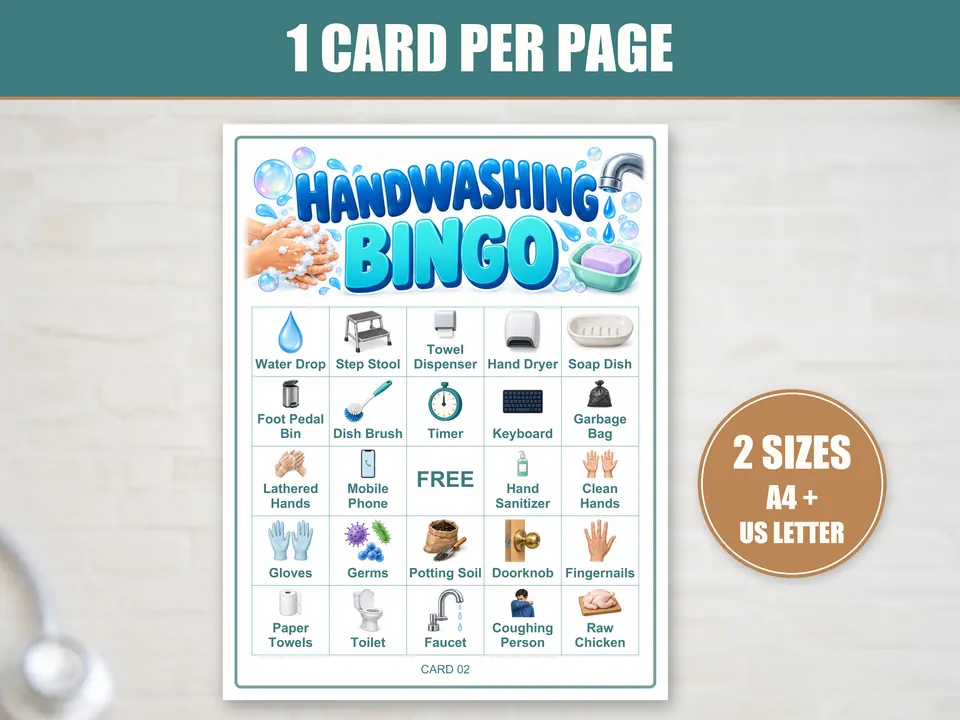
Handwashing Bingo has 50 different player cards and 36 matching picture calling cards. Each board has 24 pictures and a FREE center. The theme includes Hand Soap, Soap Bubbles, Lathered Hands, and Paper Towels, so the activity starts with matching pictures rather than asking colleagues to perform.
Pick this when someone can stay to call and check wins. Print a different card for each player, prepare removable markers, and keep the complete calling set together. Agree on a row, column, or diagonal before the first call. Don't introduce a new winning pattern halfway through because the lunch queue has moved.
The moment it works is small: two colleagues compare where the same picture sits on their cards, and somebody who usually skips group games joins the next round. You don't need to manufacture more excitement than that.
For the complete printing and calling sequence, follow the handwashing bingo host guide. This page helps you decide what belongs in the break; that guide handles the game itself.
People trickle in? Put out a puzzle
The Handwashing Awareness Week bundle contains 25 games, including Word Search, I Spy, Spot the Difference, Handwashing Trivia, and Charades & Draw. You don't have to run all 25. Start with one page whose rules fit the space and the people you expect.
For a quiet table, inspect Word Search or a picture challenge first. Put pens beside the player pages and keep any answer key with you. Tell people where and when they can check an answer, so a self-paced activity doesn't turn into a hunt for the organizer.
For a gathered group, read the selected game's rules before promising pair or team play. Objective puzzles and quizzes have answer keys; open-answer party games use their own page rules and scoring. The bundle also includes a contents page and host guide to help you find the right material.
Acting rounds can be fun with a willing group. They needn't be the default. The listing calls for pretend props, with no water or cleaning products needed. A staff social should leave the break table usable afterward.
Print only the pages you'll use
Both products are digital downloads, so the finished game won't arrive in a box. Decide which activity you're running before sending anything to the printer. Printing a complete bundle because you haven't chosen a page yet creates a sorting job you didn't need.
For bingo, the four PDFs contain the same 50 cards in A4 and US Letter, each with one-per-page and two-per-page layouts. The full Letter edition has 58 pages; its two-per-page counterpart uses 29 sheets before extra token copies. Print only the player pages you need plus the support pages for your game.
The activity bundle's full-page Letter and A4 files each have 50 pages; its two-up editions use 25 landscape sheets. Full-page editions provide the largest text. Test a sample before choosing smaller pages just to save paper.
Send the thank-you to every shift
Write the invitation in plain language: “There's an optional handwashing-themed game in the break room. Join when your break allows.” Add the actual location and your planned window.
If the morning group gets a hosted game, offer another hosted opportunity when later staff can attend. Leave the calling cards, checklist, and instructions together for the next host. Clear used boards before handing them over. A half-finished game with no caller isn't much of a welcome.
You can also run a free activity without a printable purchase: give everyone a blank note and invite them to thank a colleague for a specific helpful action. Deliver the notes privately or ask permission before displaying them. Include reception, cleaning, administrative, and other colleagues who help the clinic function.
Keep that prompt about appreciation. Don't ask people to identify coworkers who need better habits or turn the notes into an informal scorecard.
Stop before the break runs out
Announce your stopping point before play begins. If work interrupts, pause without blaming the person who needs to leave. You can finish at the next agreed opportunity or simply thank the group and pack away. An unfinished optional activity is easier to recover from than a break that overruns.
For bingo, check every square in a claimed winning pattern against the drawn calls and share simultaneous wins. For a puzzle, make the answer reveal easy to find. Thank people for joining rather than praising only the highest score.
These are party games, not training, so keep formal instruction in its own slot. For another event with similar attendance challenges, borrow the handoff ideas in night-shift team huddle games.
Questions and answers
Can we play with fewer than 50 people?
Yes. Print one different bingo card per player and keep a separate caller. You do not need to print all 50 player cards.
Do we need water or cleaning products?
No. The acting rounds use pretend props, so nothing gets wet. Set out only the pens or markers your chosen game needs and the break table stays clear.
Is there a free activity we can run?
Yes. Hand out blank paper and ask each person to thank a colleague for one specific thing they did this week. Deliver the notes privately. It costs nothing and works for people who miss the game.