GoodHolidayStore planning guide
Healthcare Quality Week Without Another Meeting
Your Healthcare Quality Week invitation is starting to look suspiciously like another meeting: agenda, presentation, action points. Cut it down to one optional game, a short thank-you and a finish time you can keep. Pick an activity after checking who is coming and how long they can stay. The person who planned the celebration should be able to put their notes away and join in, too.
Give the gathering one purpose
Write the invitation as a social break. Include the room, start time, finish time and the fact that playing is optional. If you have operational announcements to deliver, schedule them separately so the appreciation time has a clear beginning and end.
Ask who is likely to attend. A group made entirely of colleagues who work together daily will need less introduction than a table mixing quality staff, administrators and people visiting from other departments. For the mixed group, leave a moment for names before distributing pages.
Count the chairs and usable table space. If people will be balancing paper on a knee, reduce the group size or find a better place before printing. An activity that needs writing should have somewhere to write.
Select the game by its directions
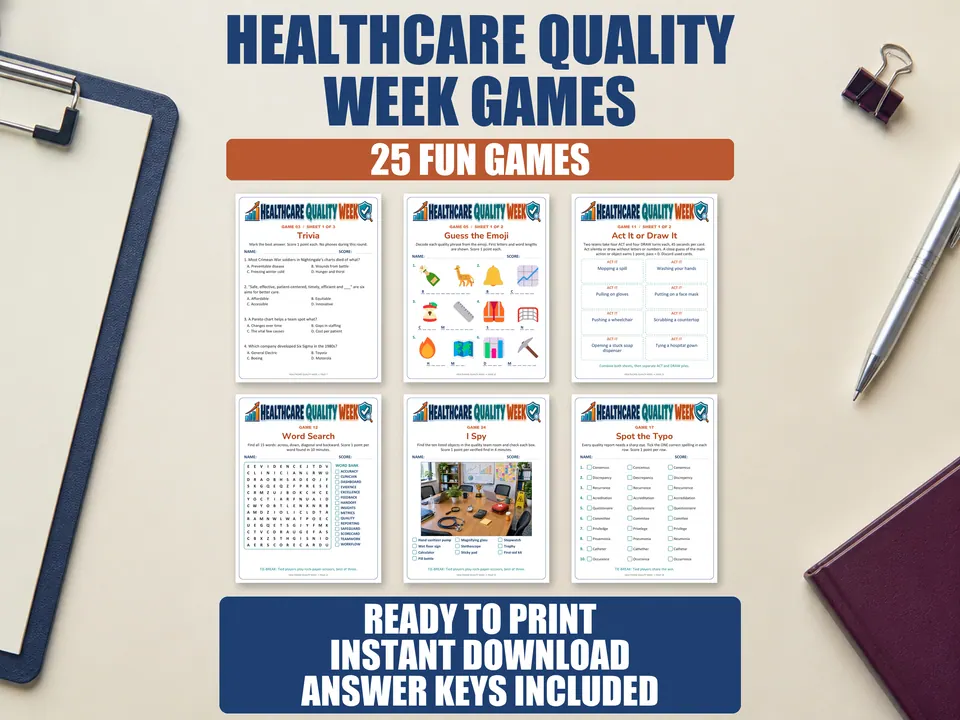
The Healthcare Quality Week bundle contains 25 games, a contents page and a quick host guide. Answer keys are included for objective games; open party rounds use the scoring on their pages. Start by reading the contents page, then open one activity and its instructions.
Choose a page you can explain plainly to the people attending. Check whether everyone needs a copy, whether there are host materials and how the game ends. If you can't give a clear explanation after reading its directions, select another activity before the gathering begins.
For a quiet table, look for an activity whose printed rules let people work from their own pages. For a group that enjoys talking, inspect an open party round and decide if its directions fit your space. You have options in the bundle; you don't need to introduce several at once.
Think about the people least familiar with the topic. Offer a partner and let them read the page before starting. Keep discussion on the printed activity and ordinary colleague appreciation; leave real incidents and case details out of the game.
Make mixed-role pairs easy to join
Ask, "Would you like to work with someone?" Then let willing players choose a nearby partner. Avoid assigning a confident colleague to supervise someone else. The pair needs room to talk through the game, not another reporting relationship.
Read the page's instructions before changing the format for pair play. Decide how many player sheets a pair needs and explain any agreed adjustment before starting. Keep the printed answer key with the host until the reveal, so one table doesn't accidentally see it first.
If a person prefers to work alone, leave them that option. If somebody wants to watch, give them a seat without a sheet. Once the group starts, keep the same invitation open to people arriving late: join where it makes sense, or wait for the next fresh start.
For a very small group, sit together at one table and check answers at the end. There's no need to invent team names, appoint captains or maintain a wall of scores. The shared conversation can carry the gathering.
Fit the activity inside the break
Plan the event around the time available, then use the selected activity's directions to decide how far you'll get. Tell everyone at the start that you'll stop at the agreed finish. Save unfinished pages if the group wants another opportunity later.
| Part of your planned window | What happens | Host's cue |
|---|---|---|
| Arrival | Welcome people and offer a seat | Say when you'll finish |
| Start | Explain one selected game | Show the instructions and offer pairs |
| Main activity | Let the group play | Help with rules without taking over |
| Closing | Reveal answers where relevant and thank the team | End at the stated time |
This is a run order, so adjust the space each part gets to your actual break. If arrivals take longer, shorten the activity instead of pushing the finish later. People should be able to trust the invitation you sent.
Print a small stack and a separate host copy
The full-page US Letter and A4 editions each contain 46 pages. The two-up editions each use 23 landscape sheets, with the same game content. Pick the edition that matches your paper and print only the selected activity's player pages and required host materials.
Print a sample before making copies for the group. Read the text at the distance players will use. The smaller layout saves paper, but choose a larger one if that's what lets people participate comfortably.
Keep the answer key and host instructions in a separate folder. For a later gathering, replenish blank player pages and leave a note naming the activity and any format decisions. The next host should have enough information to start without reconstructing your event.
Close with a thank-you people can keep
Prepare a short message naming helpful things the team has done for colleagues. Ask permission before reading anyone's personal note aloud. Leave time for the thanks rather than squeezing it in while people are already standing up.
A free addition is a blank note with the prompt, "One thing I appreciate about working with you is..." Deliver those notes to people who attend and people who miss the gathering. Finish your delivery list after the tables are cleared; that is the part of the celebration worth completing.
Questions and answers
Does every activity in the bundle have an answer key?
Objective games have answer keys, while open party rounds use the scoring printed on their pages. Read the directions for your selected activity before telling the group how the answers or scoring will work.
Can colleagues outside the quality team join?
Invite them and offer willing players a partner from another role. Review the selected activity first so you can explain unfamiliar game instructions without putting one person on the spot.
What can we offer people who skip the game?
Leave space for them to sit and talk, or deliver their thank-you separately. Include them in the recognition message without asking for a completed sheet or a reason for sitting out.
Do we need a prize for the highest score?
You can finish with a shared answer reveal and thanks instead. If you do offer a prize, explain how ties work before play and keep the recognition for the whole team separate from the result.