GoodHolidayStore planning guide
New Year's Eve Family Games With One-Minute Turns
The kids want a game, the adults want to stay in their chairs for another minute, and nobody wants an hour of rules. Start a New Year's Eve family challenge session with a small handful of one-minute cards. Gather their supplies, demonstrate the first turn, and let people join as players or helpers. The short turns give the evening some energy without requiring you to run all fifty challenges before anyone gets dessert.
Build a shortlist instead of a marathon
Select three challenges you can prepare fully
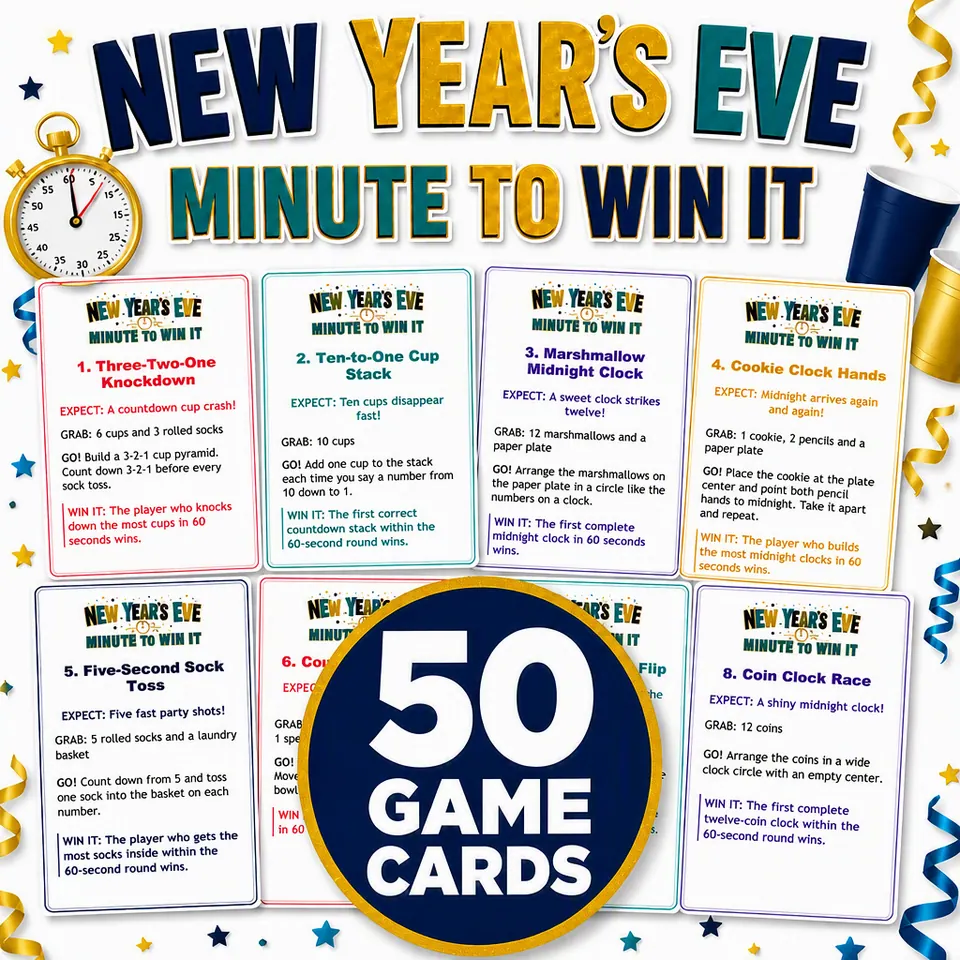
Open the card set before inviting everyone into the game area. Choose three cards whose instructions and supplies you can manage in your room. Three is a suggested starting plan; you can add another once the family has tried the first set.
Read each chosen card through, including its winner rule. Think about who will play, where the task will happen and what needs moving afterward. Put the remaining cards aside. A stack of fifty options is useful for choosing, but it doesn't need to become tonight's to-do list.
The New Year's Eve challenge printable contains 50 unique cards with clear 60-second play and winner rules. Its simple English instructions are written for children, families and mixed-age gatherings. That saves you from inventing fifty activities; your job is to choose the ones that fit this particular family.
If you want a free warm-up, ask everyone to name one ordinary thing they're looking forward to next year, with passing allowed. Keep it conversational and unscored. Then introduce the prepared challenges as their own activity, with their own printed directions.
Put each card beside its supplies
Print your cards and pack separate trays
The download has a 14-page US Letter PDF and a 14-page A4 PDF, with a quick host guide in each. Cards are arranged four per sheet, with two on the final sheet. Choose your paper size and locate your selected cards in the print preview before printing.
Gather the exact physical supplies listed on those cards. Put each game's materials and printed instructions together on a tray or a clear section of the table. Add a timer and a place for used materials. The files are digital PDFs; the household kit is your part of the preparation.
Give the play area a quick trial with one person. Check that the player can reach the materials, the timer is visible to the timer keeper, and spectators have somewhere to sit. Keep small loose pieces away from children who put objects in their mouths. Move snacks to another surface so you can reset without collecting crumbs with every prop.
Let everyone see a turn before they take one
Explain the goal before starting the clock
Read the selected card's instructions and winner rule, then show a brief practice attempt. Name the start and stop signals. Ask if anyone needs the directions repeated before you press the timer; a timed round feels much better when the player knows what they're trying to do.
Offer solo turns or a paired practice round, depending on the task and your players. For a mixed-age group, you can choose cooperative attempts instead of comparing a young child's result with an adult's. Announce that hosting choice before play so nobody learns a different scoring rule after their turn.
Spectating can be a real role. Ask a willing family member to keep time, read the next card, or return supplies to the tray. Avoid assigning a shy guest a public performance as their first job of the night. Let them watch a round and decide how they'd like to join.
Finish the selected set and then ask for more
Stop, reset and give the room a breather
End each attempt at the stated signal, check the result using the rule you explained, and reset the materials before the next player. If you're recording results, use one sheet with names or team names rather than trying to remember everyone's total over the noise.
After the last selected card, pause the session. Put the timer down, clear the play surface and ask if people want another challenge or a break. Bring out one more prepared card only when the room wants it. The unused deck can wait for another gathering.
The one-minute limit belongs to the attempt, not the whole family event. Give demonstrations and resets their space, and you can enjoy the funny moments instead of rushing people through them. A few well-prepared cards are enough to make a shared game session feel complete.
Questions and answers
Does a one-minute game take only one minute to host?
The cards have 60-second play rules, but explaining, demonstrating and resetting take additional time. Select a small set and leave room between turns instead of scheduling a new card every minute.
How many challenge cards come in the download?
You get 50 unique cards and a quick host guide in each PDF. There are US Letter and A4 editions, each 14 pages, with four large cards per sheet and two on the final sheet.
Are the physical game supplies included?
The download contains digital PDFs only. Read your selected cards before the party and collect the physical supplies they call for in separate trays.
Can children and adults play together?
The set is written for families, children and mixed-age parties, with simple English instructions. Demonstrate your chosen cards and offer paired turns so younger players can ask for help before the timer starts.