GoodHolidayStore planning guide
Bible Study Games Without the Trivia Spotlight
You ask the room an open question and get a long, friendly silence. Fix it by giving everyone something to look for before anyone has to speak. In Bible picture bingo, the host reads a label and shows an illustration while players mark their boards. You get a full round of matching, then one optional conversation afterward. Nobody has to prove how much Scripture they remember just to sit at the table.
Tell them the job is matching, not remembering
Say exactly what they'll do: listen to a picture label, look at the illustration, and cover it if it's on their card. Demonstrate on a board before you shuffle the callers. People settle into the pattern without having to invent an answer in front of the room.
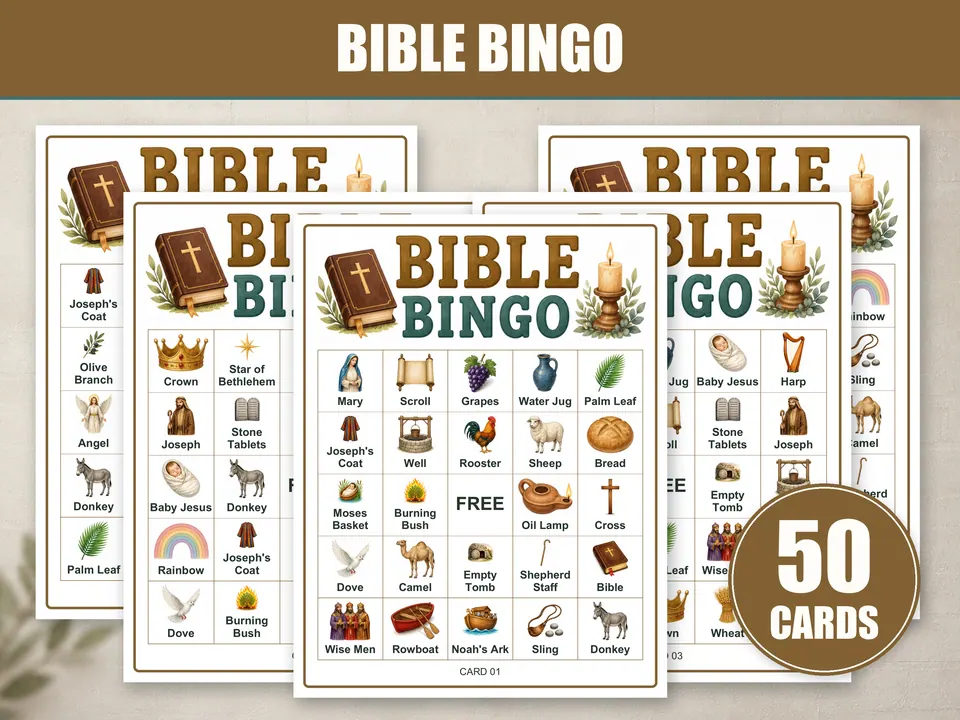
Bible Bingo has 50 illustrated player cards and 36 calling cards. The picture pool includes Noah's Ark, the burning bush, stone tablets, Nativity figures and the empty tomb. The same exact labels appear on the boards and the callers, so the host can identify every picture without guessing.
It's a good opener when your group mixes lifelong readers with people just starting out. Don't add a rule that players must explain the story behind a picture before they can mark it. That turns a shared matching game into the knowledge test you were trying to avoid.
Print for the people at your table, not all 50 boards
Pick one edition. The download has four fixed PDFs: US Letter and A4, each with full-page or two-per-page player cards. Full-page files have 58 pages and two-per-page files have 33. Those totals include support pages, so a small group doesn't need the whole document.
All four editions contain the same 50 boards, so printing all four won't give you 200 different cards. Select one player card per participant, one complete calling set, the checklist and enough markers. Read the host guide before the group arrives, while the printer is still within reach if you missed a page.
For a small table, put a sample board where you'll sit and check that the pictures are easy to see. Full-page boards give more room, while two-per-page sheets save paper and need a center cut. Print at Actual Size or 100% on matching paper and inspect the first sheet before running the rest.
- Player cards can go on ordinary white paper.
- Cardstock makes callers and markers sturdier.
- Cut the complete calling set before people sit down.
- Give each person enough removable markers.
Call it slowly, show every picture
Mark the center FREE square first and agree on a winning pattern before the first draw. Five in a row, a column or a diagonal gives everyone the same target, and the supplied instructions also allow a full-card game. Explain your choice once, loudly enough for everyone.
Shuffle all 36 calling cards. Read each exact label aloud, hold up the illustration and give people time to match. Keep the drawn cards together and tick the caller checklist. That small habit lets you check a claimed bingo against the actual calls instead of someone's memory.
When someone calls bingo, compare every square in their pattern with the drawn cards. Share simultaneous wins. To play again, clear the removable markers and reshuffle the complete calling set, including the cards already drawn. Keep a spare bowl beside you so used callers don't drift back into the undrawn pile.
| Moment | What the host does |
|---|---|
| Before the draw | Explain the winning pattern and mark FREE |
| Each call | Say the label and show the matching illustration |
| A bingo claim | Check the pattern against retained callers |
| Another round | Clear markers and reshuffle all 36 callers |
Ask one optional question after the game
A quiet group often needs a little thinking time. When the round ends, invite a single optional response about a picture people noticed. Try: "Which picture would you like to hear more about next week?" That's an original host question, separate from the supplied game.
Let someone point at a picture instead of speaking at length. If several people answer, take them one at a time and link the topic to a passage you've chosen for your study. Bring your own Bible reference before you invite discussion. The game is a picture-matching set, not a lesson plan with an answer key.
You can also skip the discussion and go straight into your study. The game has already given people a shared experience and a few easy exchanges across the table. You don't have to squeeze a teaching point out of every caller or ask anyone for a testimony.
The illustrations are artistic interpretations. When you discuss a story, go to the text you're studying and let that guide the conversation. Then the picture activity and the study support each other, and nobody argues about the details of an illustration.
If the room stays quiet, ask less of it
Quiet doesn't mean the game failed. People may be concentrating, tired or simply enjoying the pictures. Look for practical barriers first: can everyone hear you, see the caller and reach their markers? Fix those before adding louder encouragement.
If someone wants to watch, give them a comfortable seat and let them join a later round. If the room gets chatty, pause the next draw instead of talking over the conversation. The game is there to support fellowship, and sometimes the conversation is the part worth keeping.
No printable? Name one Bible story you've already studied and ask pairs to recall a picture or object from it. They tell each other why it stuck, then rejoin the group. You supply the prompt, with no boards to print and no winner to announce.
Before you pack up, put the entire calling set in one envelope with the checklist. Store clean boards flat and keep the markers separate. Next time you'll start with a ready game, not a search for the missing dove.
Questions and answers
Does everyone need to know the Bible stories?
No. Players match the shown picture to the exact printed label, so no trivia answer is needed. Keep any story discussion optional and offer it after the round.
How many different boards are included?
50 player boards, repeated across four paper and layout editions. Pick the format you want instead of printing every file.
Can we play without writing?
Yes. Players cover the matching pictures with removable markers. For another round, clear the boards and reshuffle all 36 callers.