GoodHolidayStore planning guide
Host Christmas charades without the awkward first turn
The charades cards are on the table, and everyone is suddenly very interested in their drinks. Aunt Linda has already announced she doesn't do charades. Take the first turn yourself, say that guessing counts as playing, and make passing normal.
Print and cut the cards beforehand so nobody spends the welcome wrestling with scissors. Here's the setup, from PDF to a first round everyone understands.
Print and cut the 32 cards before the doorbell
Print one complete size
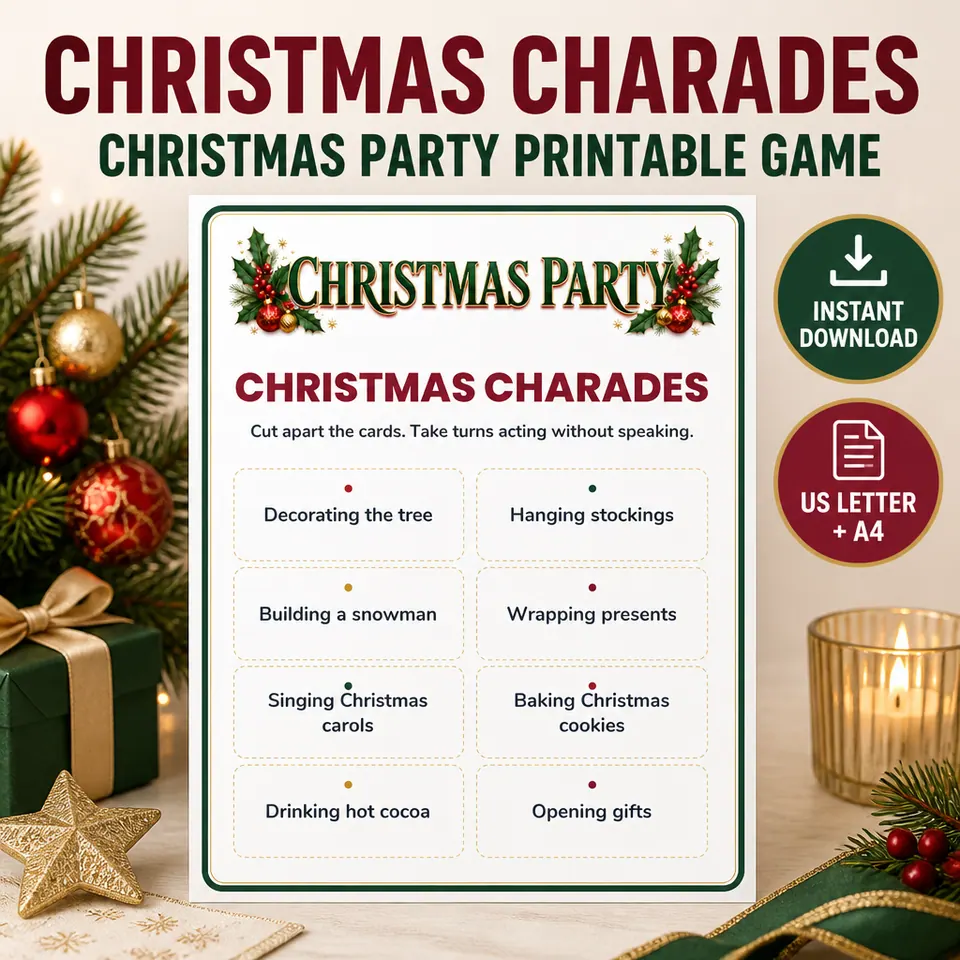
Christmas Charades includes 32 cut-apart cards in two non-editable PDFs: four pages in US Letter and four in A4. Select the file matching your paper. Print a sample page first and check that the text and card edges look comfortable before printing the remaining pages.
Cardstock is sturdier for cut-apart cards, but plain paper is fine for one party. You only need one set of prompts for the whole group, not a deck per guest.
The cards save you from inventing prompts on the spot. You still supply the printer, scissors and a clear space.
Cut, shuffle and separate the used pile
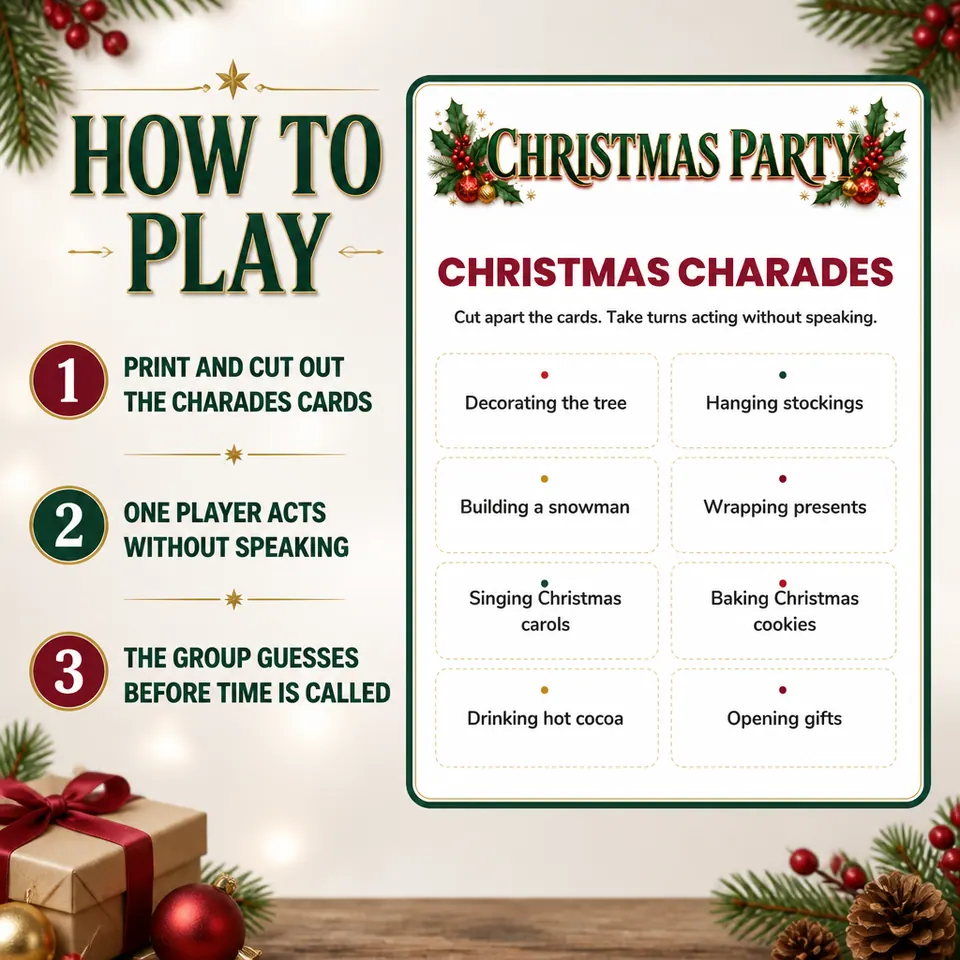
Cut the printed cards apart before guests arrive. Shuffle them and place the stack face down where the next actor can reach it without showing the group. Put an empty dish or a clear patch of table beside it for played cards.
Read through the set privately so you know what you are asking people to act. If a prompt doesn't suit your particular gathering, leave that card aside. Don't preview answers aloud while people are taking their seats.
Explain the rules in one breath, and make passing okay
Offer acting and guessing roles
Clear a small visible area away from drinks, chairs and breakable decorations. Invite seated acting too; a performance doesn't need to involve crossing the room. Check that the group can see hands and expressions from where they sit.
Say: “Act without speaking while the group guesses. You can pass on a card, or stay on the guessing side all night.” Silent acting and group guessing are the game's rules. Passing and guess-only roles are your host calls, so announce them before the first draw.
You don't need to describe every possible gesture. Demonstrate the basic idea and answer a real question when it comes up. A long debate about what counts as a sound can eat more party time than the game itself.
| Decision | Easy host arrangement |
|---|---|
| Timed or untimed | Agree before the first scored turn |
| Competitive or shared | Teams for a score, or one group guessing together |
| Difficult card | Let the actor pass and draw again |
| Someone dislikes performing | Invite them to guess throughout |
Show one unscored turn yourself
Take a card and act silently while the group calls guesses. Don't begin by assigning the most reluctant guest a performance. Your demonstration gives everyone permission to look a little silly without putting a newcomer on display.
When somebody guesses the card, show it and move it into the used pile. Explain how you'll recognize an acceptable answer. If you want exact wording, say so; if a clearly equivalent answer counts, say that instead. Consistency matters more than making a clever guess lose on a technicality.
Play a short round, then ask who wants another
Play a short sequence, then ask before continuing
If using timed turns, keep the timer where the host can manage it and announce the chosen length. Try 60 seconds in your practice turn and adjust before anyone counts points.
For a cooperative round, count successful guesses together if people want a target. For teams, explain your own points and turn rotation first. Stop after an agreed number of turns and ask if anyone wants another round.
If the same two people call every answer, invite a different part of the room to guess first on the next turn. Let younger players team with someone who can read their card privately. Helping someone understand a prompt is different from whispering its answer across the room.
When snacks arrive or conversation takes over, put the pile away. You don't have to use all 32 cards to have hosted the game properly. Keep unused cards separate from played ones if you hope to return later, and let the next round begin with a fresh volunteer.
Questions and answers
How many pages should I print?
Choose either the A4 or US Letter PDF. Each has four printable pages containing the same 32 cut-apart cards; you do not need both sizes.
Does everyone have to act?
No, and saying so is what gets reluctant guests to play. Tell the room that guessing is a full role, nobody has to perform, and anyone can pass a card. You'll usually find the "I don't act" people are the loudest guessers.
What timer setting does the game require?
None. Charades works untimed or timed. If you want a timer, try 60 seconds per turn, test it on your practice round and change it if guests are either bored or panicking.
Can I change the printed cards?
Not in the PDF, but you can add your own. Write extra prompts on blank cards (family in-jokes work well) and shuffle them into the pile.