GoodHolidayStore planning guide
A Crohn's and Colitis Social Where Anyone Can Opt Out
You want your Crohn's and colitis group to enjoy each other's company without retelling their stories again. Plan one quiet activity, seats near the door and a standing permission to leave. And ask first whether the group wants a condition-themed game at all. Some people will love it; others want an ordinary chat.
Ask what the group wants before you print
Send a short question with the invitation: "Would you prefer a quiet puzzle, picture bingo, or time to talk?" Offer a private way to reply. You don't need to collect health information to learn that someone would like a seat near the door or a larger printed page.
Be clear about what the gathering includes. If you plan to offer condition-themed pictures or awareness trivia, say so beforehand. Let people decide without having to inspect a game after they've already sat down in a group waiting to begin.
If nobody replies, keep the plan flexible rather than assuming yes. Set a modest suggested social window, such as 30 minutes, with permission to arrive late or leave early.
You can say: "We'll have an optional activity and space to sit together. You can watch, join, or step out whenever you like." Follow through when someone takes the exit option.
Set up seating with a clear way out
Check the venue before inviting people. Find out where the toilets are, how guests reach the room, and who can answer access questions. Share practical information plainly so people can decide whether the venue works for them.
Arrange seats with a clear route out. Put supplies where people can reach them without passing everything around a crowded table. If you have a choice, offer both a shared activity area and somewhere to sit without playing.
Avoid asking guests to explain an absence. A simple "glad you're back" is enough when somebody returns. Don't announce that the group has been waiting for them or ask another member to account for where they went.
| Hosting decision | A welcoming approach | Question to settle beforehand |
|---|---|---|
| Arrival | Let guests settle before inviting play | Who will greet newcomers? |
| Seating | Leave a clear route to the door | Can guests move without interrupting? |
| Activities | Make joining and passing equally easy | Does the group want this theme? |
| Food | Keep participation independent of eating | What venue arrangements do guests need to know? |
| Photos | Ask before taking or sharing images | Can people attend without appearing in pictures? |
Food doesn't have to be the centerpiece. If refreshments are part of the plan, tell guests what's being offered and let them make their own choices. Don't ask them to justify what they eat or decline.
Offer a puzzle nobody has to finish
The Crohn's and Colitis Awareness Week bundle contains 25 games, a contents page, and a host guide. It includes IBD Word Search, I Spy, Spot the Difference, Great Minds Think Alike, IBD Awareness Trivia, and other options. Read the actual pages before selecting one for your group.
A word or picture puzzle is worth considering when people want something to do with their hands while conversation develops. Guests can look at the page, work with a willing partner if the rules allow, or leave it untouched. Don't require every page to be completed before the gathering moves on.
The bundle includes answer keys for objective puzzles and quizzes. Open-answer games have their own rules and scoring on the page. Keep the relevant key with the host and offer an answer check when someone wants it, rather than turning the reveal into a compulsory group test.
The listing makes personal sharing optional. Keep that boundary in your hosting too. Avoid adding questions about symptoms, treatment, diagnosis, or whose experience best matches a prompt. You're making space for a social activity, and guests can choose what they discuss.
Picture bingo, if the group votes yes
If the group prefers a shared caller-led activity, Crohn's & Colitis Bingo provides 50 different player-card arrangements, 36 calling cards, a checklist, and a host guide. Each player board has 24 pictures plus a FREE center.
The pictures include Small Intestine, Colon, Stomach, and Endoscope. Mention that anatomical and care-related imagery before inviting the group to play. Picture matching removes the need to answer trivia questions, but it doesn't remove the theme itself.
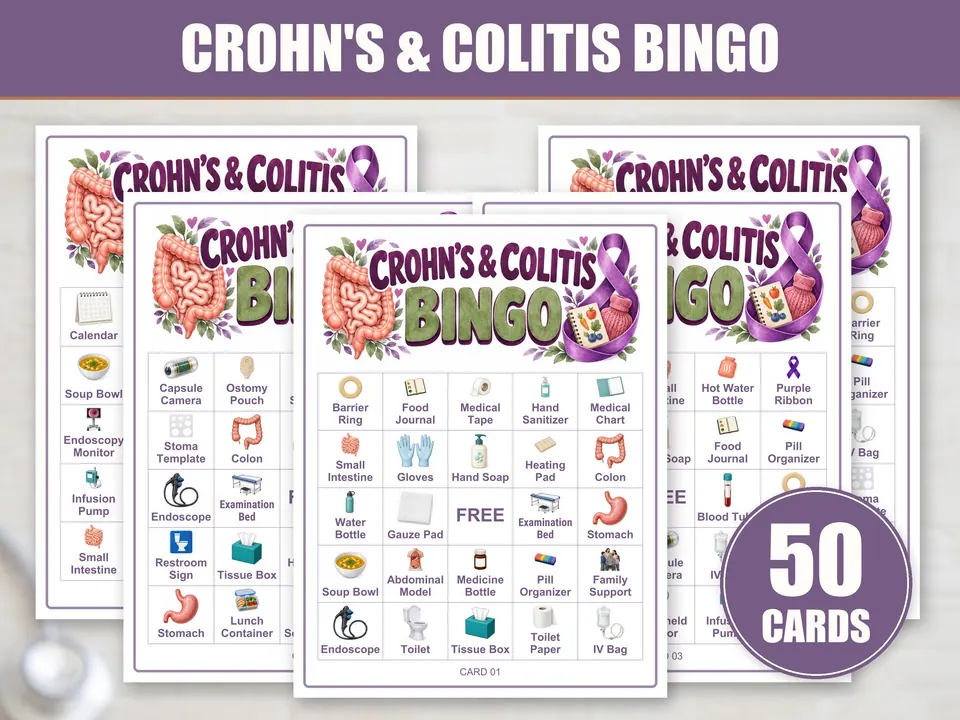
Give willing players different cards and removable markers. Mark the FREE center, agree on a row, column, or diagonal, and shuffle the full calling set. Show each drawn picture and read its exact label. Keep calls together and check every square in a claimed winning pattern. Share simultaneous wins.
Agree that someone can pause or leave without explanation. If a player returns, quietly show the calls already drawn if they want to catch up. Don't make the whole room watch the return. If several people stop playing, thank everyone and move back to conversation.
Print big, cut early
Both products provide A4 and US Letter PDFs in full-page and two-up layouts. The awareness bundle has 54 pages in its full-page Letter edition and 53 in A4; both two-up editions use 27 landscape sheets. Select the game first and print only what you'll use.
The bingo files contain the same 50 cards in all four editions. Full-page files have 58 pages, and two-per-page files have 29. A bingo token sheet has 36 markers for one player, so print additional copies or provide your own removable markers.
Test a page before printing the group set. Full-page bundle editions provide the largest text. For two-up files, select one PDF page per printed sheet because the layout already pairs the pages. Finish cutting before guests arrive so your attention is available for welcoming them.
Keep the purchased files with you and hand out printouts, not PDFs, to stay inside the listing's use terms.
The free version: paper, pens, no prompt needed
For a free alternative, put blank paper and pens on the table. Offer this original prompt: "One ordinary thing I've enjoyed lately is?" Guests can write, talk, draw, or pass. Make it clear that an answer doesn't need to connect to health or offer a positive lesson.
You can also leave the paper blank and invite conversation without a prompt. A shared table doesn't need a scored activity to be worthwhile. Allow a pause instead of immediately filling every quiet moment with another question.
Before closing, invite private feedback about the room and format. Ask what would make the next gathering more comfortable, without requesting personal explanations. Thank guests for coming, including those who watched or stepped away. These are social games, so if someone asks for treatment advice, point them to their care team.
Questions and answers
Do guests have to share personal experiences?
No. Say so at the welcome, let anyone pass without explaining, and keep symptom and treatment questions out of the game entirely.
Is the bingo free of medical imagery?
It includes anatomical and care-related pictures such as Colon, Stomach, and Endoscope. Preview the cards and ask whether that theme suits your group before planning a round.
Can we host without buying a printable?
Yes. Put out blank paper and pens with one light prompt, like "one ordinary thing I've enjoyed lately", or just make room to sit and talk. A table with snacks and no agenda counts as a social.
What if someone leaves during bingo?
Let them step away without explanation. If they return and want to continue, quietly show the drawn calls. Pause the activity if the group needs a change.