GoodHolidayStore planning guide
Diabetes Awareness Bingo Without the Awkward Quiz
Your team wants to mark diabetes awareness, but nobody wants lunch to turn into a quiz about their own health. Run an optional picture-bingo round, with a quiet puzzle on the side. Say it up front: no diagnoses, no medical questions, and the person who just wants to eat is welcome.
Invite people with no strings attached
Try this wording: "We're taking a staff break during the week. There's optional picture bingo, or you can just sit with us. No personal health questions." Add the room, start time and finish time. That gives a hesitant colleague something concrete to accept.
Don't ask people to identify who has diabetes, describe medicines or explain what's on their plate. Even a well-meant "you must know this one" can turn a shared game into an unwanted spotlight. Read a picture label and move on.
Plan 20 minutes: a few to settle, a few to pack up. If colleagues only have five, skip the game and just say thanks.
Bingo for a full table, puzzles for stragglers
A caller-led round works when most people can sit down together. A puzzle works when arrivals are staggered. Don't set out every activity just because the bundle contains fifteen; that leaves you explaining rules instead of enjoying the break.
| What your room looks like | A practical starting point |
|---|---|
| Everyone sits down together | Picture bingo with one caller |
| People arrive between tasks | An optional Word Search sheet |
| Nobody wants printed games | Original thank-you notes and conversation |
The National Diabetes Month Games bundle contains 15 games across 19 activity pages, including Word Search, Word Scramble and Picture Memory. Choose Word Search if you want a quiet option. Keep its answer key with you so players can check their work without a public score announcement.
A free DIY alternative is a small stack of blank note paper. Invite colleagues to finish, "Thanks for making our team day easier by?" They can hand the note directly to someone or keep it private. Write your own example about a routine kindness, without mentioning patient details or anyone's health.
Prep one bingo round before lunch
Diabetes Awareness Bingo provides 50 player cards and 36 matching calling pictures. The labels match across the boards and calling cards, so you can show the illustration and read the exact name rather than inventing clues. That makes the hosting job pleasantly straightforward.
Print for the people who are actually coming
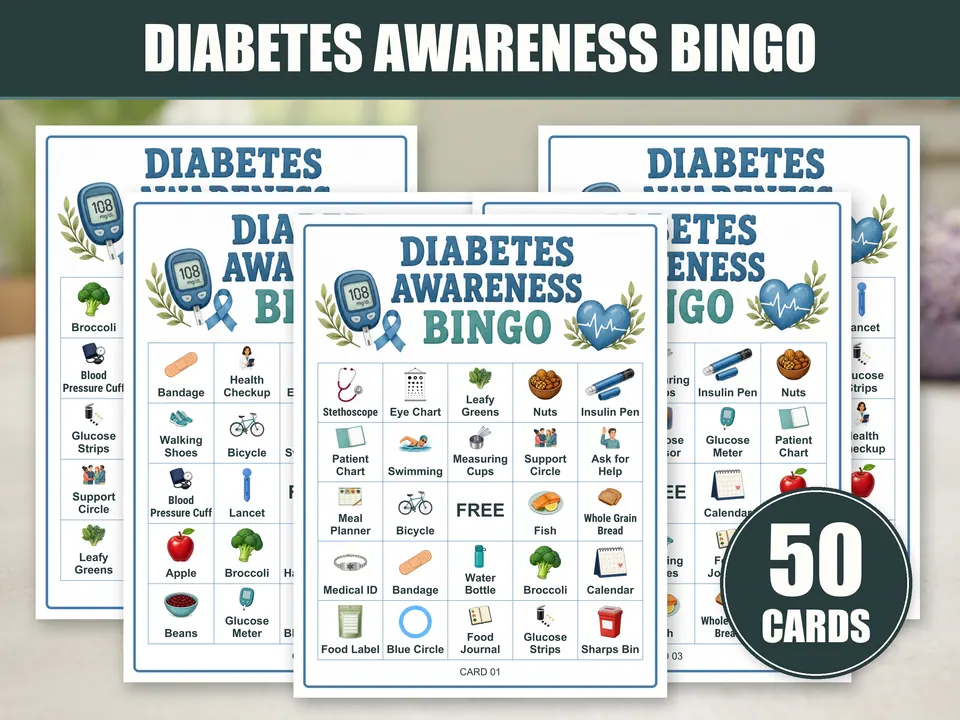
Choose US Letter or A4 and print a different player card for each person. The four PDFs contain the same 50 boards, not four separate sets. Full-page boards give more room; two-per-page boards save paper and need cutting. Try one page before you print the rest.
Put all 36 calling cards in one place
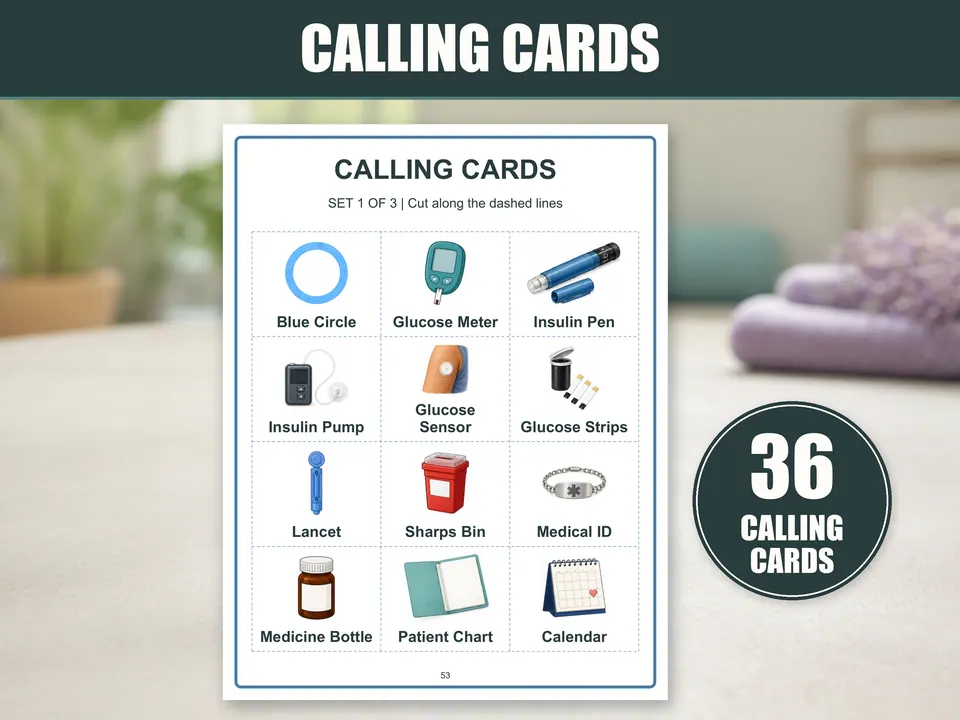
Cut the complete calling set before the gathering. Set out the caller checklist and leave a clear space for drawn cards. You need those cards to check a win, so don't drop them straight back into the undrawn pile. A tray or envelope keeps the two groups separate.
Give each player enough removable markers
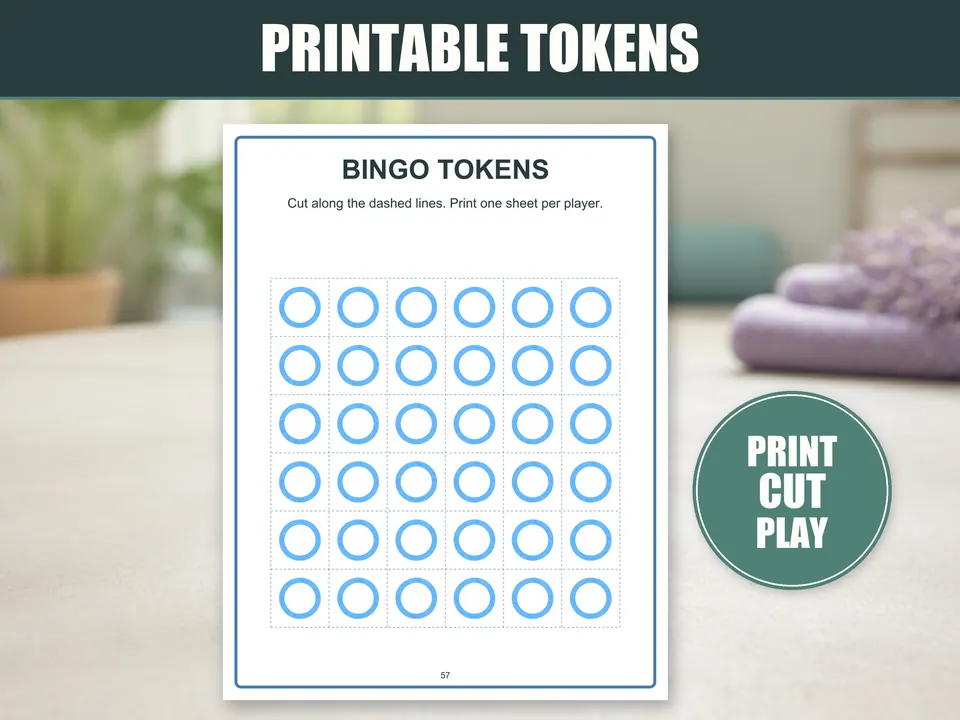
The printable token sheet has 36 markers for one player. Print extra copies for your group, or prepare your own removable markers. Mark the center FREE space before you begin. Explain the chosen winning pattern while everyone can still see their board clearly.
The full-page PDFs have 58 pages; the two-per-page editions have 29 landscape sheets. Those are complete-file counts, not a printing requirement for a small lunch. Select the player pages you need and include the host support pages. Leave your printer's Pages per Sheet setting at 1 for the already paired edition.
Call pictures, not people
Agree on a row, column or diagonal before play. Shuffle the calling set, draw one card, show it and read its exact label. Players cover the matching picture if it appears on their board. Keep the drawn cards together and track them on the checklist.
When someone calls bingo, check every square in the claimed pattern against the drawn cards. Share simultaneous wins. If you have time for another round, clear the markers and reshuffle the entire calling set.
The moment this works is small: someone recognizes a picture, finds it and settles into the table conversation. You don't need a speech after every call. The moment it stalls is when the host adds a knowledge test and people start worrying about getting an answer wrong.
If somebody asks a personal medical question, bring the gathering back to the game without asking them to explain further. You can say, "Let's leave individual health questions out of this round." Then read the next card. The social doesn't need to resolve everything raised by the theme.
Leave a kit for the next group
Colleagues who miss lunch should still receive your thanks. Set aside a fresh note and, if you're repeating bingo, a ready-to-run kit with boards, markers, all 36 calling cards and the checklist. Label the envelope so the next host doesn't inherit an unexplained stack of pictures.
For a quieter follow-up, leave the optional puzzle at an agreed staff table with pens and a collection spot for completed sheets. Don't display names beside scores. Keep purchased PDFs with the organizer rather than circulating the files.
Need help making the table work across arrivals? The break-room station guide covers that setup. For paper choices, see healthcare game printing options. Decide what you'll repeat before packing away the scissors, and the second gathering will take less thought.
Questions and answers
Can colleagues join without knowing much about diabetes?
Yes. Picture bingo asks players to match the shown illustration and exact label. Explain the rules once and show every calling card; nobody needs to share a diagnosis or answer treatment questions.
Is the bingo a clinical teaching tool?
No. It's a picture-matching party game, not a treatment checklist, and it contains no personal medical guidance. Keep it a social and send health questions to the care team.
Do I need the entire bundle and the bingo?
Pick one route. Bingo suits a shared caller-led round; the bundle offers activities such as Word Search when people prefer a sheet they can work through quietly.
What if our break ends before someone wins?
Stop at the announced time, thank everyone and save the cards for another day. Nobody remembers an unfinished board, but they do remember a break that ran long.