GoodHolidayStore planning guide
Office Christmas Icebreakers Without the Awkward Speech
You want people talking beyond their usual desks, but “tell us something interesting about yourself” has already sent three coworkers to the snack table. Start with a short conversation game that has a clear finish. Jingle and Mingle is a shared opener, Find the Guest is a simple checklist, and Secret Missions runs quietly in the background.
Pick the icebreaker that fits your office
An office party has its own geography. Finance is beside the drinks, the new starter is looking for a familiar face, and somebody is still answering a work message. A game should give people a reason to cross those little borders without making the whole room perform.
Before printing anything, decide whether you want a shared beginning or something guests can join during the evening. A shared beginning is easier to explain once. Background play needs clearer boundaries because ordinary conversation and game actions happen together.
| Your situation | Start here | Work for the host |
|---|---|---|
| People need an opening question | Jingle and Mingle | Print boards and provide pens |
| Guests enjoy completing a checklist | Find the Guest | Print one sheet each and check names |
| People are already chatting | Secret Missions | Cut cards and explain scoring |
| The team wants no organized game | A voluntary paired question | Ask one question and let conversation continue |
The last option is real. You can ask pairs to compare their favorite winter snacks, then stop hosting. You don't need a purchase to give two people an opening.
Jingle and Mingle: give quiet coworkers a question to borrow
Jingle and Mingle supplies 50 text-based boards with festive prompts and lines for matching names. Guests ask each other questions, record names and work toward the agreed winning pattern. Different people should be used when possible, and anyone may pass a question.
This solves the blank-opening problem. Instead of inventing small talk, a player has a specific reason to say hello. The conversation can continue beyond the square; you don't need to interrupt a good chat because someone has already written a name.
Print one board per player from the A4 or US Letter file. The set has full-page and two-per-page layouts, plus 36 optional conversation cards, a checklist, tokens and a host guide. For the name-writing round, boards and pens are the essential player supplies. Don't spend your last preparation minutes cutting optional pieces you won't use.
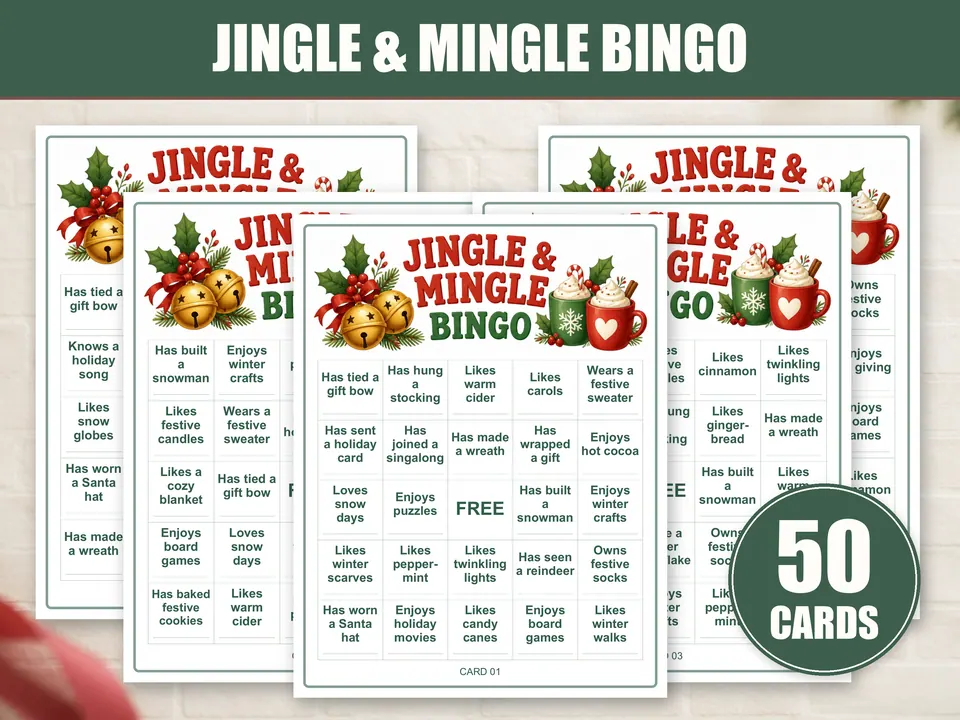
Explain one winning pattern before you begin. A row, column or diagonal gives the round a visible target; a full board asks for more conversations. Follow the included guide when checking a claim, confirming the written names and matching prompts with those people.
If colleagues don't share the same Christmas traditions, tell them passing is ordinary. Don't turn an unanswered prompt into a request for a personal explanation. You want introductions, not a surprise interview.
Find the Guest: a checklist for people who like a task
Christmas Find the Guest puts 15 festive prompts on a single sheet. Each player needs a sheet and a pen. Its supplied rules ask people to find a different guest for each clue, using each guest only once.
That distinct-name rule matters. A tiny team won't have enough other people to fill every line under the original rules. In that situation, select a different game or announce a timed, highest-score round rather than promising everyone can finish.
The listing allows the first correctly completed sheet to win, or the highest score when time ends. Pick the ending before handing out sheets. Otherwise the fastest player may expect a winner announcement while everyone else thinks they have ten more minutes.
Stand somewhere visible when checking a sheet. Ask for clarification kindly if a name or match is unclear, then close the round. You don't need to read every answer to the whole office.
Secret Missions: explain the premise first, then go quiet
Secret Missions works differently: each participating guest secretly draws an objective and attempts it during the party. It includes 100 unique cards, a how-to-play page and 17 cut-apart card sheets in each of its A4 and US Letter editions.
Read the cards before your work gathering and select what fits the team. Cutting and reviewing are part of this setup. A stack still attached to its sheets isn't ready to hand out beside the buffet.
The supplied rules award one point for a successful mission; first to three wins. Another guest can stop an attempt by saying “Secret mission!” and correctly naming the action before completion. There's also a timed option, with the highest score at the end winning.
Tell participating guests those rules together. Secrecy belongs to the individual objective, not to the existence of the game. For a team that dislikes playful accusations, the conversation sheet is likely the easier choice.
Call time while people still have something to say
For a ten-minute opener, spend the first minute explaining and the last minute checking and closing. Watch the room: in a busy venue, people need time to hear each other.
Say what happens next before the round starts: “When I call time, we'll check the scores and leave the games here.” That small sentence saves you from trying to compete with conversations you've just helped start.
Give seated guests a way to take part without circulating. Invite others to bring conversations to their table, and leave space around it. Participation shouldn't depend on weaving through a packed room.
If the game stalls, demonstrate one exchange with a willing coworker, then step back. If it still stalls, close it cheerfully and let the party move on. The goal was a warmer room. Nobody needs to finish a worksheet to earn their mince pie.
Questions and answers
What works for a small office?
Try a short Jingle and Mingle round (one row wins) or just a voluntary paired question. Find the Guest needs a different person for each clue, so a small team should use its timed, highest-score ending instead.
Is this picture bingo?
Jingle and Mingle uses conversation prompts and written names. There is no caller drawing pictures for the group to mark.
Does Secret Missions come in A4?
Yes. You get matching A4 and US Letter PDFs, each with the complete 100-card game, so print whichever size your office printer uses.
What if someone would rather watch?
Let them. Hand them a drink, skip the sheet and invite them into any conversation that's already going. Nobody has to explain why they're not playing.