GoodHolidayStore planning guide
Radiology Bingo for a Big Team, Set Up Once
You printed boards for the whole department and just realized you have markers for one person. Count first: 50 board designs, one 36-card calling set for the caller and one token sheet per player. These steps take you from the print dialog to checking a win.
Count people before pressing Print
Match your attendance to the board set
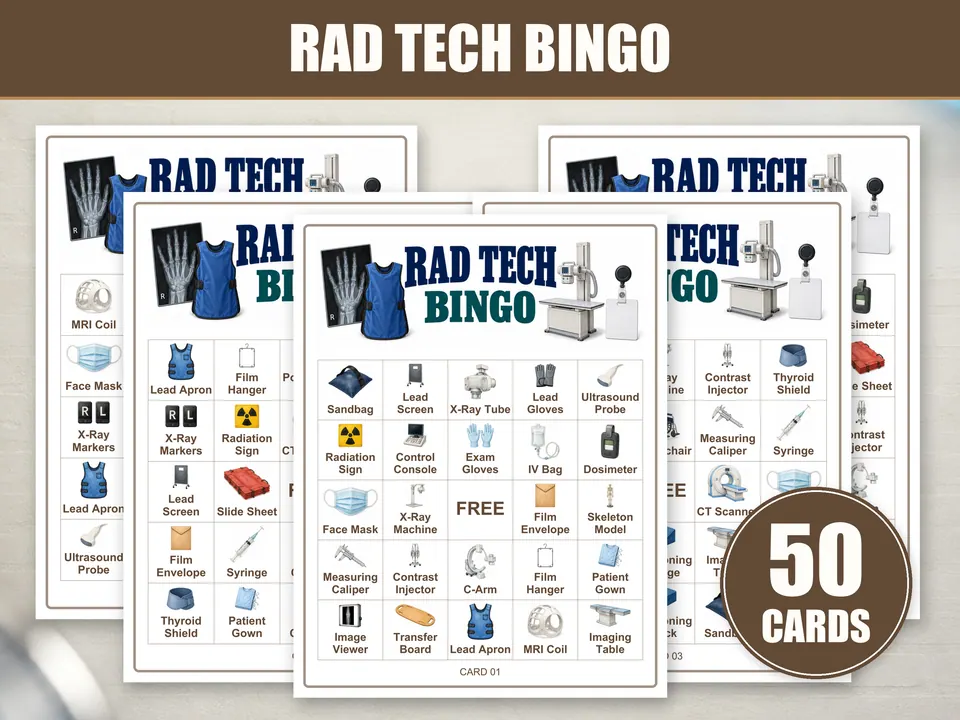
Count the people expected in this round, plus a dedicated caller. Rad Tech Week Bingo supplies 50 player boards, each with a center FREE space. Give out different boards within that set before adding duplicate copies.
If more than 50 players are coming, decide between separate sessions and duplicate boards now. Duplicate copies may win together. Tell the room you'll share simultaneous wins, as the game instructions direct, rather than improvising a tie rule after two people call out.
This is the bingo set for the shared round. The illustrated pool includes X-Ray Machine, CT Scanner, Lead Apron and Dosimeter, so the caller can read the labels and show the pictures.
Print the right pages, not all 58
Select one paper size and one layout
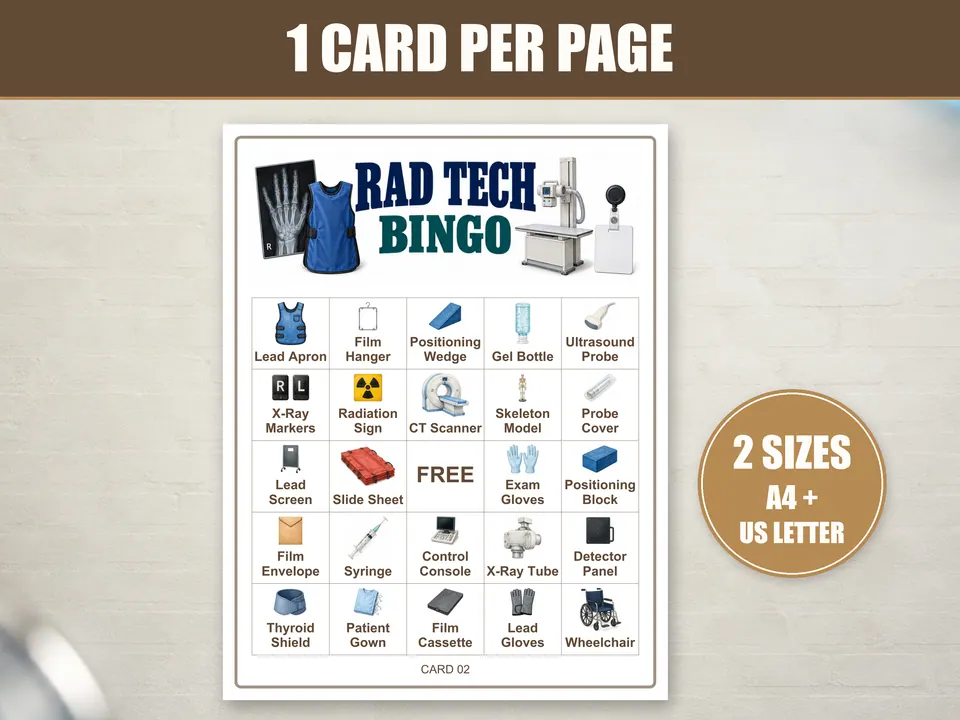
Choose Letter or A4 to match your paper. Full-page PDFs are portrait and contain 58 pages; two-per-page PDFs are landscape and contain 29 sheets. All four editions contain the same game.
Print at Actual Size or 100%, single-sided. In the already-paired two-per-page file, leave the printer's Pages per Sheet setting at one. Otherwise you'll shrink an already paired layout again.
Player boards occupy pages 3–52 in the full-page files and sheets 2–26 in the two-per-page files. Select the boards you need, then print the host support pages separately. Check the preview and one test print before sending the larger job.
| Print choice | Best reason to pick it | Remember |
|---|---|---|
| Full-page | Larger pictures and labels | One board per player page |
| Two-per-page | Fewer player sheets | Landscape sheets need a center cut |
| Extra copies | More people or another session | Copies do not add board designs |
Split the caller's pile from the players' piles
Portion markers before the crowd arrives
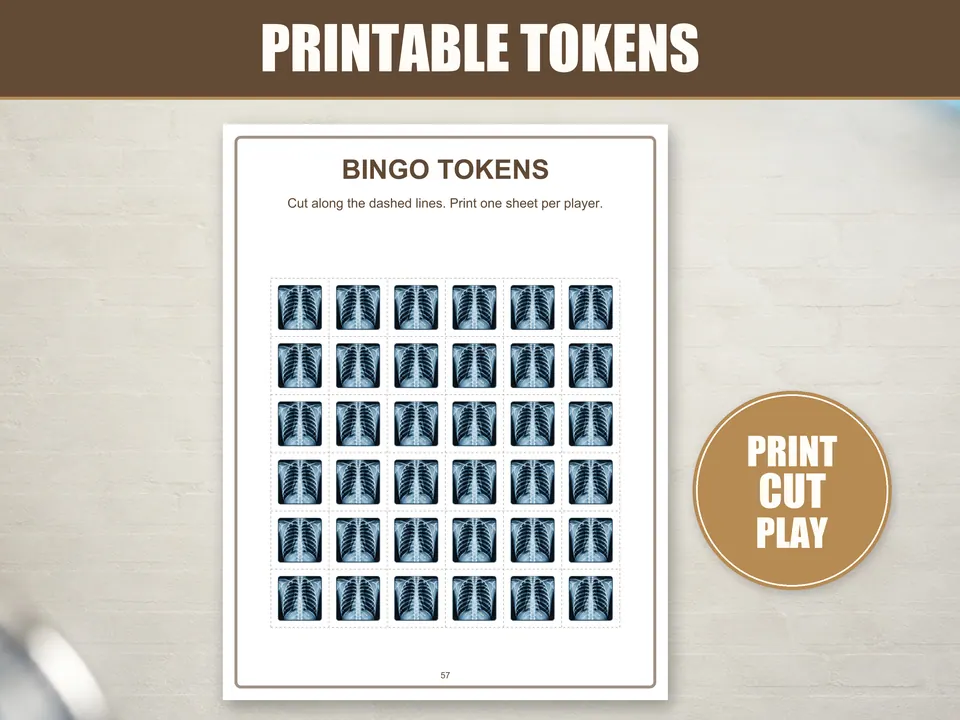
Print one 36-token sheet per player, as the listing directs, or supply suitable removable markers yourself. Cut printed tokens before the event and divide them into small containers or stacks at the seats.
Use ordinary white paper for boards; cardstock can make calling cards and tokens sturdier. Put scissors away once the sets are ready so you're not still cutting while people wait for the first call.
Keep all 36 calls with the host
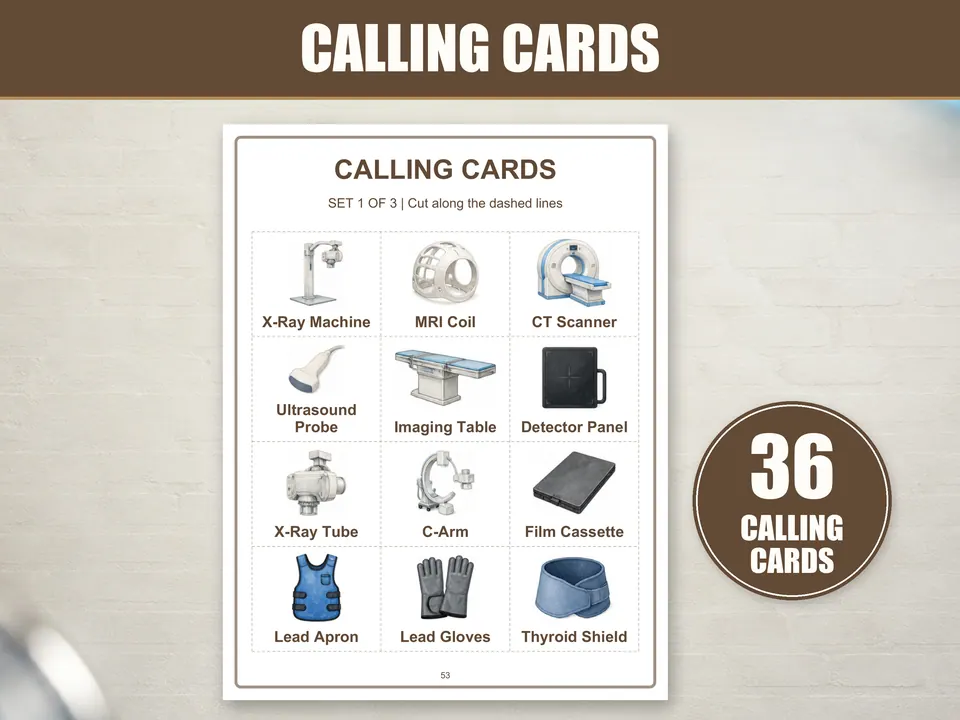
Cut the complete calling set along its guides. Shuffle it and place the caller checklist nearby, with enough clear space to retain drawn cards. Don't mix a calling card into a player's marker pile.
Stand or sit where everyone can see a picture being held up. Check the view from the far end of the table before starting. If people can't see, bring the seating closer or split the gathering into smaller sessions.
Call the round, check the win, reset
Announce the pattern before the first call
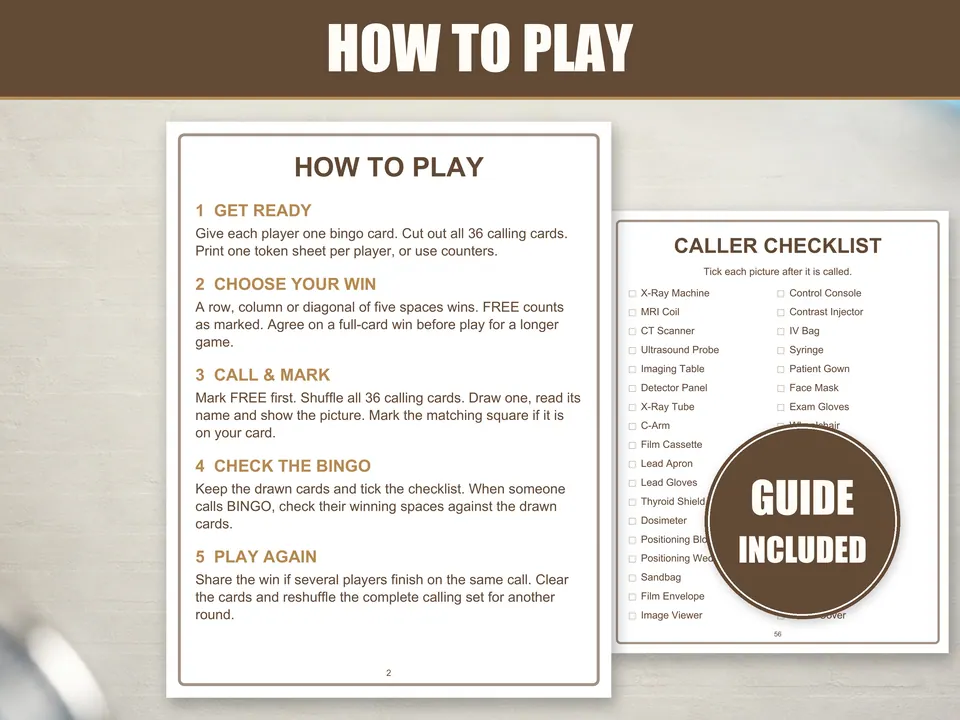
Have players mark FREE. Agree on five in a row, column or diagonal, or choose a full-card win before starting. Five in a row is the easy first round.
Draw a card, read its label and show its picture. Pause while players check their boards. Retain the card and tick the checklist. When someone calls bingo, stop and verify every square in the claimed pattern against the drawn cards.
Share simultaneous wins. For another round, remove markers and reshuffle the complete calling set. A new group should start with all 36 calls available, not the leftovers from the previous game.
Avoid distributing boards to late arrivals and telling them to catch up from memory. Invite them into the next round, or show them a separate prepared activity. The caller's attention belongs on the current draw and any claimed wins.
Late arrivals? Have a second table ready
The 25-game Rad Tech Week Games bundle includes X-Ray Room I-Spy and other picture activities. If you own it, inspect one page and its key for a separate table. It supplies a Quick Host Guide and objective answer keys.
The separate 15-game National Radiologic Technology Week pack includes Word Search, Word Scramble and Rebus Puzzles. Those are alternatives to inspect for a waiting group, not more bingo boards.
Set out only the selected activity and its directions. Keep its answer material away from bingo calls, and name someone who can help that table if needed. Or skip the second game. Lunch fills waiting time just fine.
For colleagues who can't stay together at all, the last-minute radiology guide offers a sheet-based plan. Bingo works best when the group can hear the same calls, see the same pictures and reach a shared finish.
Questions and answers
Do the four PDFs give me 200 different boards?
No. All four files hold the same 50 boards; paper size and layout change how it prints, not the designs. Fifty covers most departments. Beyond that, run two rounds.
What happens if more than 50 people attend?
Run separate sessions or knowingly distribute duplicate boards. Explain that matching boards can produce simultaneous wins and share those wins.
How many token sheets do I need?
One 36-token sheet per player, per the listing. The file includes just one sheet, so print extra copies or hand out removable markers you already own.
Can people join halfway through?
Wait for the next round. Finish the current game, clear markers, reshuffle all 36 calls, then deal the newcomers in.