GoodHolidayStore planning guide
Respiratory Bingo That Lets the Host Enjoy the Party
You're organizing the RT party, and you'd like to sit down for part of it. Build respiratory bingo as one complete kit before the gathering: boards for players, cut calling cards for the host and markers that won't run out halfway through. Then give the caller a visible seat and a simple round to lead. The party gets a shared activity, and you skip the trips back to the printer while everyone else eats.
Check the sightline before you check the game
Stand where the caller will sit and look at the farthest chair. Everyone needs to see the equipment pictures as well as hear the labels. A long table with a centerpiece in the middle makes that harder than you'd think.
Move decorations out of the sightline and put the caller somewhere visible. Leave flat space for an unused calling pile, a used pile, the checklist and a pen. Keep drinks away from the small cards, because one spill can stop the whole round.
Keep the activity in the seating area instead of spreading players around the refreshments. Someone waiting for a plate shouldn't have to guess whether a label was a bingo call or ordinary conversation. Invite people into the round before the first draw.
The pictures do the matching work
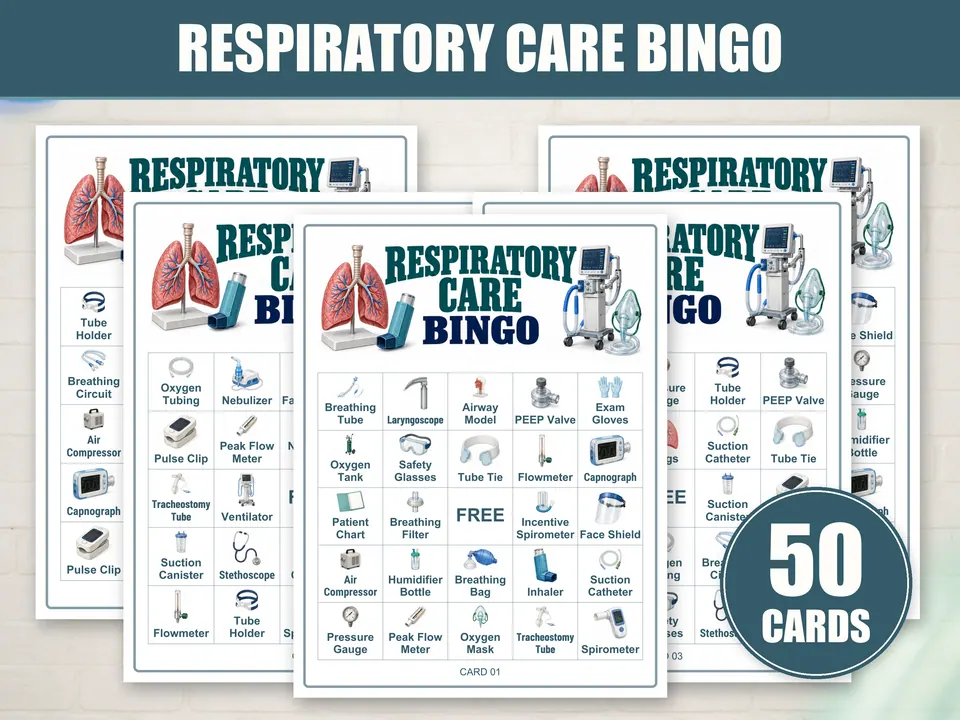
Respiratory Care Bingo uses labeled equipment pictures, including Nebulizer, Nasal Cannula, Ventilator and Spirometer. It supplies 50 player boards, 36 calling cards, a checklist, a host guide and printable tokens. Pick it for a scheduled shared round with one caller.
The four PDFs give you A4 and US Letter, each in full-page and two-per-page layouts. All contain the same 50 boards. Choose a layout for readability and table space, then print different player cards from that edition.
Full-page files have 58 pages and two-per-page files have 29 sheets. For a smaller gathering, select the boards you need plus the support pages. A test print lets you check the border and picture size before you spend paper on the full job.
Print at 100% or Actual Size, single-sided. Use portrait for full-page cards and landscape for the prepared two-up files. Keep Pages per Sheet at 1 for the two-up edition, since its arrangement is already built in.
Count the small stuff: callers and markers
Cut the entire calling set before the party. Count the 36 cards back into their container, then put the checklist and host guide with them. Cutting only some calls changes the pool, and you'll be hunting for scissors when someone asks for round two.
The current listing specifies a sheet of 36 themed tokens per player. Print enough token pages and cut them beforehand, or provide your own removable markers. Put markers at each place, so the first person doesn't scoop up the table's whole supply.
If you're reusing boards, pick markers that lift off cleanly. Keep a spare bowl for anyone who drops a few. Collecting loose markers from under the table is easier after the round than mid-call.
| Player space | Caller space | After the round |
|---|---|---|
| Different board and markers | Complete 36-card set | Clear every board |
| Clear view of the caller | Checklist and pen | Reunite all calling cards |
| Room for a plate or drink | Separate used-card area | Store the kit together |
Announce the winning pattern first
Ask players to mark FREE and agree on the winning pattern. The listed choices are five in a row, column or diagonal, or a full-card win. Say which one applies now. Changing it when somebody is nearly there starts an argument.
Shuffle all 36 calling cards. Draw one, read its label and show the picture. Let people find the match before you move on, then keep the drawn card aside and tick the checklist. A steady pace gives everyone a fair chance to keep up.
When someone claims a win, stop drawing and check every square in the agreed pattern against the cards already called. If two people win together, verify both and share the win as the rules direct. Say that at the start so nobody argues about who spoke first.
For another round, clear the markers and reshuffle the complete set. If someone arrives late, welcome them into the next round with a fresh board. That gives them a proper start, and the room doesn't have to reconstruct the calls.
Add a second game only with a fresh invitation
Respiratory Therapist Trivia has 20 multiple-choice questions, an answer key and a host guide. Use it for a separate question round after you've collected the bingo pieces. Players circle answers, and the listed scoring awards one point per correct response.
The Respiratory Care Week Games Bundle offers 25 activities, including RT Room I-Spy, Spot the Difference and Name That RT Gear. It suits an organizer who wants another format for later, with answer keys supplied for objective games.
Read the chosen game's own directions before adding it to the party. Keep the next pages packed away until bingo ends, so nobody tries to solve a puzzle while listening for calls. You can also stop after one round and let the conversation take over.
Before you leave, put the caller checklist with the complete calling set and gather the reusable markers. A ready kit makes the next session easy to host, and the organizer finally gets to sit down without wondering where the spirometer card went.
Questions and answers
Is respiratory bingo a knowledge quiz?
No. Players match the equipment pictures the caller reads and shows. If your group wants multiple-choice questions, choose the separate trivia product.
How do we reuse the same boards?
Use removable markers and clear the boards after each round. Reshuffle the complete calling set before you restart so every picture is back in play.
Can people join halfway through?
Invite them into the next round, so they start with every call available. Keep a few unused boards ready and say when the fresh round begins.