GoodHolidayStore planning guide
ER Week Games for People Who Keep Getting Called Away
You've put games in the break room, but nobody gets the same break. Someone starts a puzzle, someone else gets called to a room, and the next person in asks where the answers went. For Emergency Nurses Week, build a drop-in table around one individual activity and a clear answer plan. Save bingo for a separate shared start, so leaving halfway through a page doesn't mean missing the celebration or stalling everyone else.
Plan around the interruption
Start with the arrival pattern you really have. If people drift through all afternoon, a shared countdown will frustrate somebody. Pick a page they can set down, come back to, or take with them when the break ends.
The Emergency Nurses Week Games Bundle includes 25 games, a Quick Host Guide, and answer keys for objective games. Break Room I-Spy and Spot the Difference are two named options to check first for a page-based activity. Read their directions before deciding which one goes on your table.
Other named activities include ER Trivia Challenge, Full Moon! Dice Game, Act It or Draw It, and The Midnight Snack. They're different kinds of party material, but a bundle is no reason to put every game out at once. A dice challenge and an individual puzzle ask different things of your guests.
Make your page an unscored, pause-anytime activity? Write that invitation beside it. People shouldn't have to find a manager to learn whether an unfinished puzzle counts against them.
Write the table note that answers three questions
The note needs to say what to take, what to do when you get interrupted, and where the answers are. Keep it short enough to read standing up, and put it on top of the stack, not buried under the pages.
For example: "Take one puzzle and a pen. Keep your page if you need to leave. Answers will be in the marked envelope after the afternoon break." Set the answer time to suit your day, then make sure someone really puts the envelope out.
Prefer self-checking? Put the key in a clearly marked folder from the start and ask people to finish before opening it. This works for a relaxed table with no scores and no competition across shifts.
Give one person ownership of the setup. They don't have to guard the table all day, but they should know where spare copies live and when the answers come out. Without that handoff, everyone assumes someone else has the key.
| At the table | In the host folder | In the handoff note |
|---|---|---|
| Blank player pages and pens | Matching answer key | When answers come out |
| Short invitation | Selected game's directions | Where spare copies live |
| Space for paused pages | Any scoring instructions | Who resets the table |
Keep the answers from spoiling the table
Pin the solutions right above the blank pages and later arrivals see them before they can play. Put answers in a separate envelope or folder so checking stays a choice.
For a scored round, pick a closing time and say how finished entries get handed in. Keep completed pages away from the blank stack, because a name and an answer sheet vanish fast under untouched copies.
An unscored table doesn't need collected sheets at all. People compare with the key, enjoy the one they missed, and keep their page. No sorting for you, and the table stays useful after the first wave of breaks.
When a fresh shift arrives, swap out worn copies and reset the invitation. Give them clean player pages, not a stack covered in earlier answers. The care that makes the first table welcoming makes the later one feel intentional too.
Bingo gets a start time people can plan around
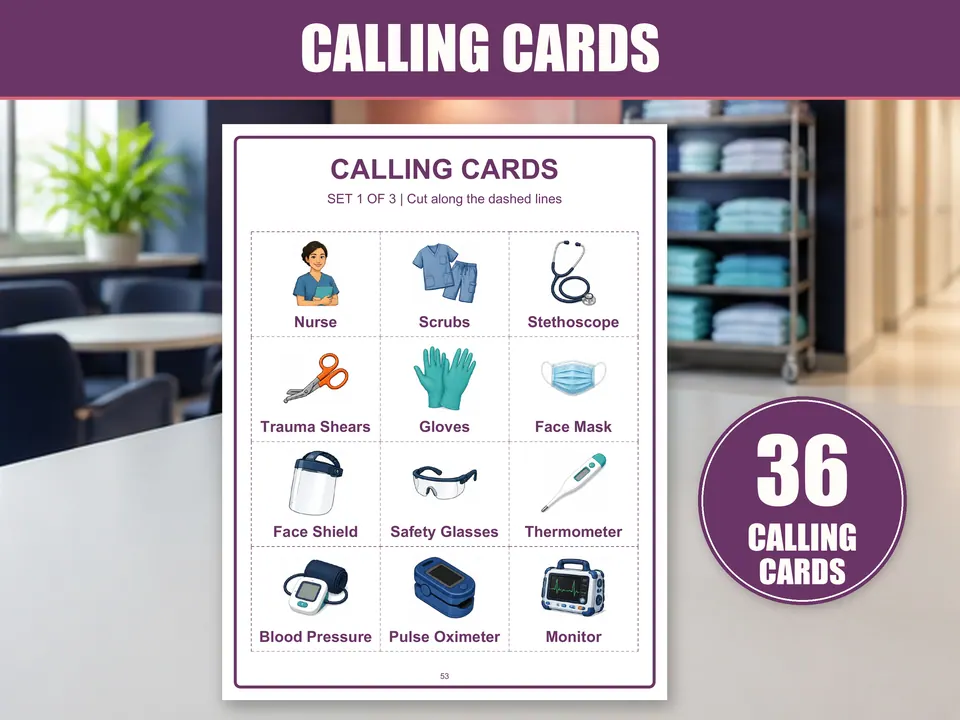
Emergency Nurses Bingo supplies 50 player boards, 36 calling cards, a caller checklist, printable markers, and a host guide. The picture pool includes scrubs, a stethoscope, trauma shears, and gloves. Pick it when colleagues can gather and follow one host together.
Post a shared start time beside the drop-in invitation. Before then, cut the calling set, put markers where players can reach them, and read the host guide. You want the first call to start the game, not a scavenger hunt for scissors.
Someone who walks in halfway through hasn't heard the earlier calls. Invite them to the next round, or point them to the individual page waiting on the table. Both beat stopping the room while you reconstruct the game.
Add a general nurse quiz only if you need one
Nurse Trivia is a general nursing companion with 20 multiple-choice questions across two player pages, an answer key, and a host guide. The ER bundle already contains ER Trivia Challenge, so look through that game before deciding you need another quiz.
Go with the standalone quiz when you want a general nursing round. Print both player pages together, hold back the key, and say when answers will be checked. If the table stays open across separate breaks, the same envelope plan works for a relaxed self-check.
The quiz listing suggests 10 to 15 minutes. Treat that as the question round, and add time for handing out sheets and reading answers if you gather people to play. Cut your own introduction down before you ask anyone to spend their whole break waiting for instructions.
Before you leave, put spare pages, the key and the table note together for the next organizer. Say what needs resetting and what can stay out. Your last job is making sure the next person can run this without calling you back to explain.
Questions and answers
Can people keep an unfinished page?
Yes, if you're running a relaxed drop-in table. Put the answer location on the invitation so they know how to check it later.
Can bingo stay out as a drop-in worksheet?
No. Bingo needs a caller and a shared sequence of pictures. Keep its start separate and offer an individual puzzle to people arriving between rounds.
How do I stop late arrivals seeing the answers?
Keep the key in a labeled envelope or folder away from the blank stack. Replace completed player pages before the next shift arrives.