GoodHolidayStore planning guide
Rad Tech Trivia That Finishes Before Lunch Does
Half your department is in the food line, one tech has a scan at 12:30, and you promised a quiz. Give trivia one small window inside lunch: explain the scoring, let people answer, read the key before anyone scatters. The standalone game is 20 multiple-choice questions with an answer key, ready to print.
Let people eat before asking them to compete
Put the quiz sheets on a side table while colleagues get food. You can invite them into the activity without placing a score sheet under every plate. Say when the answering begins and when you'll check the answers, so someone with a shorter break knows what they're joining.
The listing doesn't promise a round length, so plan your own: a few minutes to explain, a quiet answering stretch, then the reveal.
A useful opening is: “We'll do one optional radiology quiz after everyone gets settled. One point per correct answer, and we'll check it together.” It's enough information to start without a speech. If lunch is the only chance two colleagues have to catch up, let them keep talking.
Make the scoring boring so the game can be fun
Rad Tech Week Trivia Game has 20 multiple-choice questions, a printable answer key and a host guide. Topics listed include X-ray history, CT and MRI, mammography, radiation safety and imaging discoveries. The supplied scoring is one point per correct answer.
Decide on individual play or explain pairs as a host adaptation. Pairs can give a quieter colleague someone to discuss a guess with, but make the arrangement consistent. Don't let one table discover halfway through that the other table has been collaborating all along.
You can celebrate a shared high score without adding a sudden-death question. If you want a tie rule, announce your own simple rule at the start, such as sharing the win. That avoids asking the host to invent a question while everyone waits with empty plates.
Sell it as comparing guesses, not a test. Never read out the lowest score. The reveal is the friendly part.
| Your lunch setup | Suggested arrangement | Explain before starting |
|---|---|---|
| Everyone wants their own sheet | Individual answers | One point per correct answer |
| People prefer a partner | Pairs as a host adaptation | One shared answer set per pair |
| A competitive round feels wrong | Unscored group discussion | There won't be a ranked result |
Separate the key while the printer is still warm
The standalone download supplies four PDFs: A4 and US Letter, each in single-page and two-per-page layouts. Match the paper size, print at 100% and read the test copy at the distance someone will use it over lunch.
Take the answer key out before making player stacks. It sounds obvious until you're distributing a whole-file print job while someone asks where the napkins are. Keep the host guide with the key and place the player sheets in a different pile.
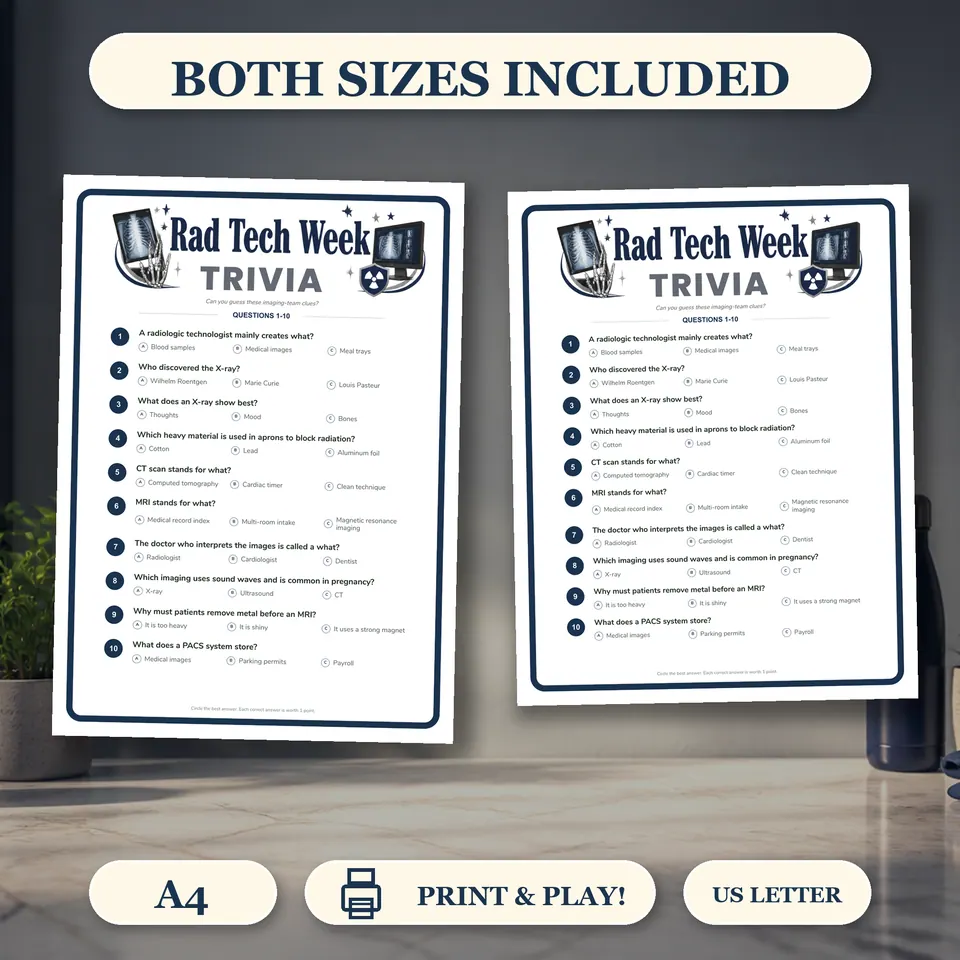
Check the full player material is present. Then count pens and leave a clean place to write beside the food. A couple of spare player copies can rescue a spilled drink without making the person feel they've interrupted proceedings.
Own the 25-game bundle? Check it first
Rad Tech Week Games contains 25 activities, including Rad Tech Trivia Showdown, Imaging Fact or Fiction, X-Ray Room I-Spy and Imaging History Timeline. Its trivia is a named bundle activity; don't assume it's the same question set as the standalone product.
If you already have that bundle, start there. Open the Quick Host Guide, inspect the activity you want and locate its objective answer key. You may find that a picture activity suits the lunch mood better than another quiz.
The bundle's Letter and A4 full-page files have 39 pages each, and the two-per-page files have 21. Some games use two pages. Print the selected activity completely and avoid using the total bundle size as your lunch agenda. There are 25 choices, not 25 jobs for the host.
For a free alternative, ask colleagues to write an original, nonclinical question about a harmless shared topic, such as favorite break snacks. Read the guesses together without scoring. Don't collect patient stories or put a coworker on the spot as the answer to a joke.
Read the answers, then stop
When answering ends, ask everyone to put pens down, then read the key at a pace that allows checking. Give people a chance to enjoy a surprising answer. A rushed list of letters is a flat ending to an otherwise good round.
Thank the group and close the quiz. People who need to leave should have a finished activity behind them. If the room still has time and interest, offer bingo as a fresh invitation rather than sliding new boards under unfinished answer sheets.
Rad Tech Week Bingo provides 50 boards, 36 calling cards, a checklist and a printable 36-token sheet in each edition. You'll need markers for all players and someone to call. The large-team bingo setup walks through that preparation.
If your caller is also clearing lunch, save bingo for another gathering. One quiz with a relaxed reveal gives colleagues a complete shared moment. They can leave knowing how it ended, and you can eat your own lunch while it's still lunch.
Questions and answers
How do we score the standalone trivia game?
One point per correct answer across 20 multiple-choice questions, so 20 is a perfect score. Decide before you start whether people play solo or in pairs sharing a sheet. For a tie, share the win.
Does the bundle contain this exact standalone quiz?
The bundle has its own Rad Tech Trivia Showdown, and its questions aren't promised to match the standalone quiz. If you own the bundle, use that and skip the second purchase.
What if lunch gets interrupted?
Pause the pens and name a new reveal time, like "answers at 12:45 whether we've finished eating or not." Anyone who has to leave takes their sheet and checks with you later.
Can we play bingo too?
Finish trivia first, then invite people to a separate bingo round. Bingo needs a caller, boards and markers, so it works best when the remaining group can stay together.